Jeremy Borelli ’12 (Anthropology)
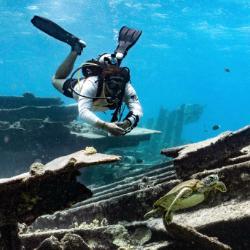 Staff Archaeologist, East Carolina University, Maritime Studies Program
As the Staff Archaeologist for East Carolina University’s Maritime Studies Program, I help coordinate archaeological research focused on shipwrecks or other submerged cultural heritage sites. Every project is different. One week I may be planning field logistics and organizing oceanographic equipment, while the next I’m diving on a historic shipwreck, conducting geophysical surveys, documenting archaeological remains, or helping train students in field methods.
New Paltz gave me more than technical archaeological skills, it taught me how to think like an archaeologist. Faculty encouraged curiosity, independent research, and collaboration, while field experiences reinforced the importance of careful observation and evidence-based interpretation. Those lessons continue to guide my work every day and helped prepare me for graduate school and a career in maritime archaeology.
The greatest benefit of a liberal arts education is perspective. It encourages you to see connections between disciplines and recognize that complex problems rarely have simple solutions. Archaeology depends on history, science, communication, and cultural understanding, and my education helped me become comfortable working across all of those areas.
Gaining this educational experience means developing your intellectual curiosity and adaptability. It isn’t simply about mastering one subject - it’s about learning how to learn. Those skills have been invaluable throughout my career.
July 2026
Logan Tierney ’12 (Anthropology, Latin American, Caribbean and Latinx Studies)
 Director of Strategic Initiatives, Montefiore St. Luke's Cornwall
I currently serve as Director of Strategic Initiatives at Montefiore St. Luke’s Cornwall, where I lead strategic planning, operational improvement, executive reporting, project management, and cross-functional initiatives across clinical, administrative, and service line areas.
My work includes translating organizational priorities into measurable action through dashboards, accountability systems, business planning, performance improvement, and leadership decision support. Over my career, I have worked across both the public and private sides of New York’s healthcare delivery system, with experience spanning state regulatory and policy work, Medicaid transformation, value-based care, hospital operations, provider strategy, service line growth, and large-scale implementation.
My anthropology studies at SUNY New Paltz helped prepare me for this path by teaching me to understand people, institutions, culture, and systems in context. That foundation continues to shape how I approach healthcare leadership: with curiosity, critical thinking, clear communication, and a focus on how strategy ultimately impacts patients, staff, and communities.
Studying anthropology at New Paltz gave me a lasting appreciation for people, culture, systems, and the ways institutions shape everyday life. That perspective has been incredibly valuable in healthcare, where operational and strategic decisions are never just technical; they affect patients, families, staff, communities, and the way care is experienced. To me, a liberal arts education means learning how to look at complex issues from multiple angles, listen carefully, question assumptions, and connect human experience to larger social and organizational systems. Those skills have helped me throughout my career, especially in roles that require collaboration, change management, public service, and thoughtful leadership.
July 2026
Parvathy Sankar ’03 (Anthropology)
 Chief of Operations, Policing and Corrections Program, U.S. Embassy - Dhaka, Bangladesh
My current position is with the U.S. Department of Justice's International Criminal Investigative Training Assistance Program (DOJ/ICITAP). I am the Chief of Operations for the Policing and Corrections Program at the U.S. Embassy in Dhaka, Bangladesh. I manage the U.S Embassy’s Counterterrorism programs and Counter Extreme Violence activities.
My liberal arts degree in anthropology prepared me for my work in international development. Anthropology professors Victor Demuck and Ed Pierce were very inspirational for me when I was at New Paltz. They encouraged me to follow my dreams.
June 2019
Tisa Loewen '15 (Anthropology)
Master's Student at New York University
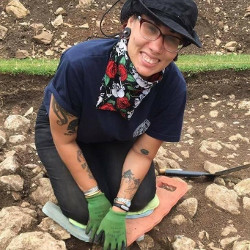
In May 2015, I graduated from SUNY New Paltz with a bachelor’s degree in Anthropology. Since then, I have been strengthening my skills in the biological and archaeological aspects of anthropology as a master’s student at NYU. Over the summer, I attended bioarchaeological field school in Spain, and currently I intern at the American Museum of Natural History. Recently, I was accepted as an American Association of Physical Anthropologists Ethics Committee fellow for 2017-1018. I have also been working with Zadar University and SUNY New Paltz Associate Professor of anthropology Kenneth Nystrom on analyzing a skeletal collection from the archaeological necropolis in Nadin, Croatia for my master’s thesis. In the fall, I will be presenting media from this work at the 2017 American Anthropological Association Annual Meeting. At this time, I am preparing applications to Ph.D. programs in biological anthropology where I will research skeletal biology as it relates to identity construction, admixture, as well as dialogues on biological affinity in anthropology.
Having trained in 4-field anthropology, which incorporates biological, archaeological, linguistic, and cultural studies, I have come to value interdisciplinary perspectives, a hallmark of liberal arts education. As a nontraditional student that worked for many years before finishing college, I find that this educational package allows me to engage the academic community confidently. This approach gave me not only skills in critical thinking and social awareness, but also modern scientific methodology and an appreciation of ethical practices. Finally, as I work toward a career in anthropology, I am mindful to highlight the importance of diversity in academia, evolution in the classroom, and continuing education in science in hopes of sharing with others the excellent training imparted to me.
April 2017
Fran Mascia-Lees ’76 (Anthropology)
 Professor of Anthropology, Rutgers University
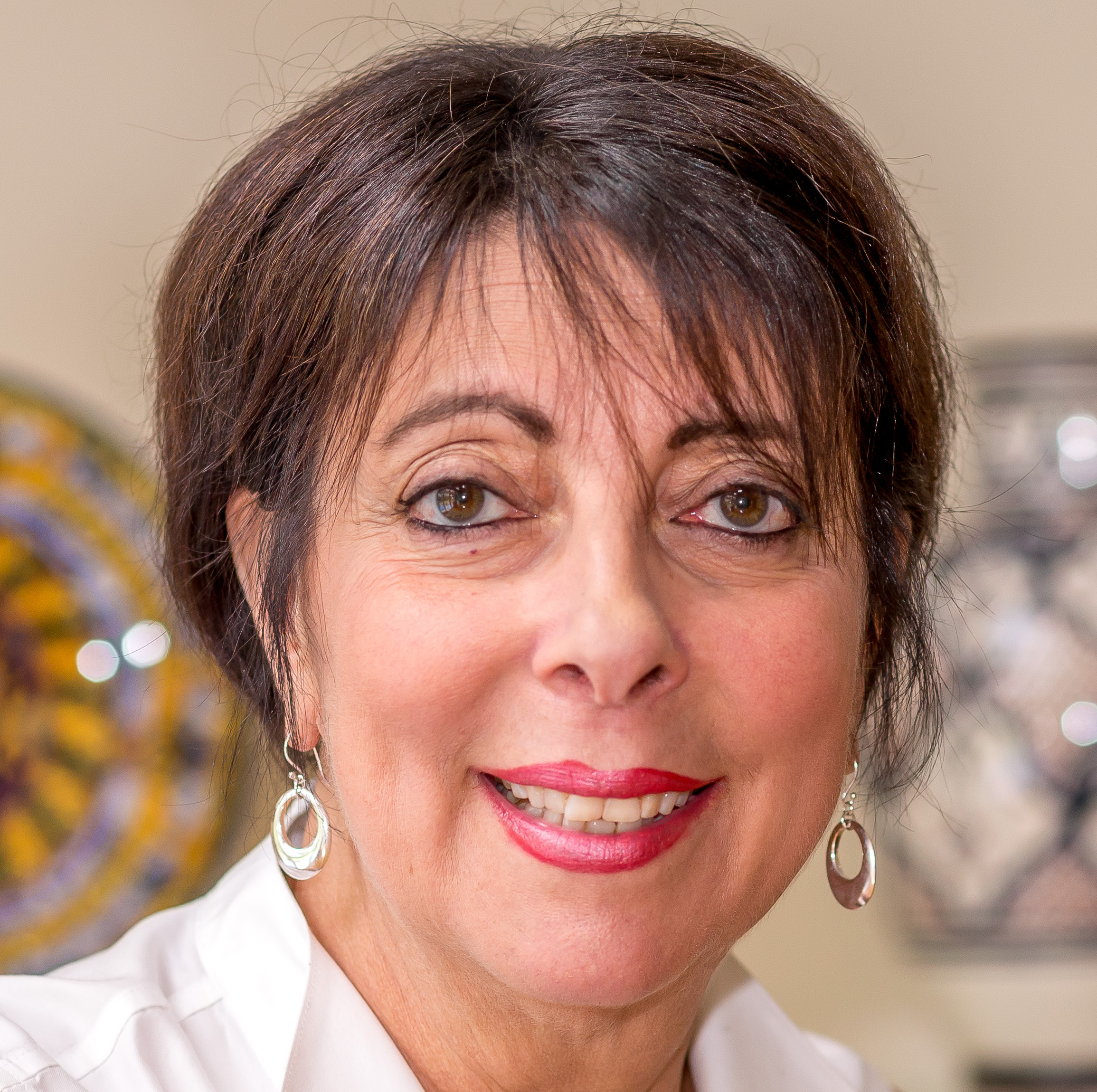
I began my career as an anthropologist at SUNY New Paltz. I graduated in 1976 with a degree in anthropology and soon went to SUNY Albany for a Ph.D. in cultural anthropology. It was the 1970s, a time of social unrest not only in the United States but also across the world. Resistance to the Vietnam War and colonialism as well as to the inequality of women and minorities in the United States had not just been in the air since the 1960s but had been taken to the streets. Colonized people fought for independence while, in the U.S., the Civil Rights Movement grew stronger and women—both minority and white—began to reveal, analyze, and fight oppression in the home and the workplace. I became active in these protests and found anthropology—with its emphasis on thinking independently, appreciating differences among groups, standing against ethnocentrism, and pursuing social justice—the perfect discipline to pursue my commitments within the academy. I wrote my dissertation on variation in women’s status across cultures and went on to teach about this and a wide range of other topics, first at a small, experimental liberal arts college and then at a large public university.
Although anthropology is inherently interdisciplinary and has served as the foundation for my inquiries and teaching, other courses I took at New Paltz rounded out my understanding of inequality and injustice, including Sociology, Women’s Studies, and History. A course on World War II, for example, fueled what became my life-long attempt to understand Nazism and genocide. In my undergraduate education, I honed critical thinking skills, learned how to form abstract concepts, and gained the capacity to evaluate evidence and to write with clarity and precision about the topics and issues that intrigued me. It was this foundation on which I built over the years to publish seven books and 50 academic articles and to lecture nationally and internationally on a wide range of topics, including the body as a site of social injustice, consumer culture as a location from producing oppositional identities, and the politics of knowledge in underwriting social and cultural inequalities, whether in representations and practices in popular science, Hollywood and ethnographic film, or the tourist industry.
As Editor-in-Chief (2001-2006) of the American Anthropologist, the flagship journal of the American Anthropological Association, I reviewed and edited articles in cultural, biological, and linguistic anthropology, in archaeology, and in a number of other disciplines. I chaired the Department of Anthropology (2004-2009) and served as Dean of Social and Behavioral Sciences at Rutgers University (2011-2014).
In addition to my academic endeavors, I have tried to put my commitments into action. I recently had the opportunity to do so as an International Scholar for the Open Society Institute (2011-2014), in which I mentored young scholars across Eastern Europe. In this role, I have worked with faculties of cultural studies in Bulgaria, anthropology in Kosovo, and gender studies in the Republic of Georgia, all seeking emancipation from the restrictive structures and practices embedded in academia under communism. A rich and broad undergraduate education was the basis on which I have built a career in anthropology over the last 40 years.
April 2016