


In an emergency,
first always call campus police (845-257-2222)
or 911
DEPARTMENT OF THEATRE ARTS SAFETY HANDBOOK
All faculty, students, and staff in the Department of Theatre Arts have a responsibility to themselves and their department to promote and practice high safety standards. The following rules and guidelines are intended to promote a safe and healthy environment.
Please see the University's Emergency Response Plan, with specific attention to the following sections and corresponding page numbers:
- Lockdown / Shelter in Place (p. 11)
- Active Shooter (p. 14)
- Hostile Intruder/Violent or Suicidal Individual (p. 17)
- Bio-Threats / Suspicious Letters or Packages (p. 19)
- Bomb Threats (p. 22)
- Evacuation (p. 25)
- Fire Evacuation (p. 27)
- Hazardous Spills (p. 28)
- Natural Disasters / Weather (p. 29)
- Serious Injury/Illness/Mental Health Emergency/Discovery of Death (p. 34)
- Pandemic (p. 37)
- Terrorist Attack (p. 40)
- Power/ Utility Failure (p. 41)
Please see the SUNY New Paltz University Police website for more information on campus safety resources, safety alerts, programming and trainings, forms, and more.
Please see the SUNY New Paltz Office of Emergency Management's website for detailed information on active shooter/hostile event preparedness.
Please see the SUNY New Paltz Environmental Health and Safety website for detailed information on reporting procedures for on-the-job accidents, injuries, and illnesses.
Please see the SUNY New Paltz Office of Environmental Health and Safety website for information on the SUNY New Paltz Right to Know policy on working with hazardous chemicals.
Please see the SUNY New Paltz Office of Environmental Health and Safety website for information on lockout/tagout procedures, which cover the servicing and maintenance of machines or equipment in which the unexpected energizing or start up of the machines or equipment, or release of stored energy, could cause injury to employees.
Please see the SUNY New Paltz Office of Environmental Health and Safety website for information on SUNY New Paltz's hazardous materials contingency plan.
Please see the SUNY New Paltz Office of Environmental Health and Safety website for information on portable ladder safety procedures.
Please see the Occupational Safety and Health Administration (OSHA) website for information on fall protection.
Please see the SUNY New Paltz Office of Environmental Health and Safety website for information on the University's occupational exposure control plan regarding blood-borne pathogens.
Please see the personal protective equipment (PPE) guide on the SUNY New Paltz Office of Environmental Health and Safety website.
Please see the SUNY New Paltz Office of Environmental Health and Safety website for information on noise and hearing conservation in the workplace.
Please see the SUNY New Paltz Office of Environmental Health and Safety website to read the University's respiratory protection policy.
Please see the SUNY New Paltz Office of Environmental Health and Safety website for guidance on glove selection for specific chemicals.
Please see the Occupational Safety and Health Administration (OSHA) website for general information on medical and first aid personnel and supplies.
Please see the Occupational Safety and Health Administration (OSHA) website for guidelines on hand and power tool safety.
Please see the SUNY New Paltz Office of Environmental Health and Safety website for information on fire safety on our campus.
Please see the Occupational Safety and Health Administration (OSHA) website for information on federal standards, hazard recognition, solutions, and resources when it comes to properly ventilating occupational work environments.
Shop Safety
Costume Shop Guidelines/Regulations/Rules
- All students must have the permission of the shop manager or costume design faculty to work in the costume shop.
- Phones and other personal technology devices are not allowed in the costume shop or other costuming areas unless you have received explicate permission from the costume shop manager, costume design faculty and/or your supervisor
- Headphones are not allowed in the costume shop or other costuming areas unless you have received explicate permission from the costume shop manager, costume design faculty and/or your supervisor. If you have obtained permission to wear headphones you must keep one ear uncovered and keep the volume low enough that no one else can hear what you are listening to.
- Consent must be obtained by the Actor and Costume Designer before taking and/or posting to social media any photographs. Photos of costumes may not be posted to social media before opening night under any circumstance.
- Large bags, backpacks, coats and other packages need to be left in the greenroom.
- Keep work areas tidy, clean and free of large obstructions.
- Upon completion of a project, your work areas must be clear of tools, pins, fabrics etc.
- All tools and supplies must be put away when finished with a project.
- Report any malfunctioning or broken tools to the shop manager or assistant shop manager at once.
- Report supplies that need to be reordered to the shop manager immediately so they can be restocked.
- Dyes, paints and adhesives shall never be used in the costume shop. They should be used in designated areas in the craft room, CT 20 or the loading dock.
- Dyes, paints, and adhesives shall not be used in the craft/laundry room while show laundry is being done
- Paper or plastic should always be placed over any work surface while using paints, dyes, adhesives, etc.
- Students shall never use lighters or matches in any of the costume areas.
- Appropriate work and protective clothing must be worn in work areas such as:
- Gloves when dyeing, painting or using adhesives
- Protective eyewear when sawing or sanding
- Aprons or other covering clothing when dyeing or painting.
- There is no eating allowed in the Costume Shop
- Food and drink must be contained and kept away from cutting tables and work areas. All food garbage must be thrown away in the outside dumpster.
- No drinks are allowed on the cutting tables, sewing machine areas or any other costume area. All drinks, including water must stay on the stainless steel countertop in the costume shop or in the green room.
- Never operate machinery or enter a work area while under the influences of alcohol, drugs or medications that may make you inattentive or drowsy. Do not operate equipment or tools when you are overtired.
- All injuries, no matter how slight, or any accident which causes damage to property shall be reported immediately to the Costume Shop Manager.
- Hallways, doorways, and entries shall be kept free of construction in accordance with fire code regulations
Costume Storage Guidelines
- Costumes are not lent out without permission of the Costume Shop Manager to individual students for class rehearsals or performances
- Instructors may request costume items for final class projects in advance of the performance dates. They must return items in good condition, promptly after performances. Instructors are responsible for laundering these items if necessary as well as properly pulling and re-stocking
- Only authorized student employees, student designers, assistant designers or crew members are allowed in costume storage
- Costumes checked out for “Blackbox” productions must be returned dry cleaned and washed within two weeks of the closing date. The Director and/or Stage Manager should schedule this return with the Costume Shop Assistant to restock items
- All students who use costume storage must keep it tidy and organized. Designers and their assistants are responsible to restock unused pulled items prior to strike of their show
- All pulled costumes must be re-labeled prior to re-stocking
- Costumes and accessories may not be placed on the floor of the costume storage
- All doorways, entries, open areas, and hallways must be kept clear of boxes, clothing racks, supplies, etc.
- Boxes may not be stacked higher than 24” below the ceiling as per fire code regulations
- Costumes and accessories must be checked out with Costume Shop Manager, and must be checked in at the time agreed upon in advance.
Costume Policy
- All Actors are required, without exception, to wear any and all items of clothing, jewelry and accessories provided and designated as the costume design. All designated pieces are to be worn as per the designer’s instructions. Costume design is fixed at opening and cannot be changed without consulting the designer, Director, and Stage Manager.
- No smoking, eating or drinking (other than water) while in costume.
- Do not touch costume pieces, wigs, and/or make-up that are not assigned to your character.
Costume Fittings
Costume fittings are used to create details and fit on built garments or to determine what alterations may be needed on existing items. Accessories, wigs and other special items may also be fit at this time. The Actor and Costume Designer, Assistant Costume Designers and Costume Shop Manager must be present at fittings. The Patternmaker, First Hand and Costume Crafts Technician must attend fittings as needed.
- Actors may be called for up to one hour.
- Actors will be notified of fitting requests by at least 24, and will coordinate times with the Stage Manager.
- Non-mandatory requests may be made with less than 24 hour notice.
- Appropriate undergarments must be worn by the performer.
- No fewer than two other people will attend a fitting with one performer.
- Fittings should be conducted in a courteous and businesslike manner.
- It is the responsibility of the Costume Design Assistants to prepare the fitting room according to the Fitting Check List before fittings and to clean the fitting room and re-stock all un-needed items after each fitting.
- Fitting Photos: Consent must be obtained by the Actor and Costume Designer before taking and/or posting to social media any photographs. Photos of costumes may not be posted to social media before opening night under any circumstance.
Fitting Room Checklist
The following checklist must be completed prior to each fitting by the Costume Design Assistants and/or costume shop employees and costume construction TAP students:
Clean:
- Straighten and organize rack: diddy bags, rack dividers
- Clean and tidy floors and surfaces
Designer Needs:
- SKETCH! and/or research, hardcopy
- Undergarments: bra, petticoat, paniers, slip...
- Jewelry and accessories
Fitting Tools:
- Clipboard, plenty of fitting note cards
- Safety Pins: small, medium, large straight pins
- Large scissors, snips, seam rippers
- Scrap Muslin
- Shoulder pads
- Hem puffer
- Oaktags
Measurements
- Clipboards, extra measuring sheets
- Measuring tape, 60" and 120"
Writing/Marking
- #2 pencils—sharpened!
- Sharpies, black & white multi-color pack
- White wax tailors chalk
- White tailors pencils, pens
Tapes/Elastic
- Black and White ¾” elastic Black ¼” elastic
- 1” white grosgrain (for labels)
- ¾” neutral grosgrain
- Scotch tape, masking tape Bra elastic
Miscellaneous
- Hair clips
- Band Aids
- Shoe horn
- Gum
Rehearsal Costumes
Rehearsal clothing can include both basic and specialty items that may affect the movement, breathing, or action of a performer. Actors are required to assemble their own basic rehearsal costume items.
These items are to include:
- Character shoes
- Suit jacket
- Hat with brim
- Full long skirt
- Gloves
Specialty items may be requested by the Director through the Stage Manager. The Costume Designer or Assistant Costume Designer will provide these items and are responsible for re-stocking them. The Stage manager will be responsible for the borrowed items and shall return them to the costume shop prior to first dress.
Stage Makeup
All performers must provide their own basic stage makeup kits. Any specialty or effects makeup will be provided by the costume department.
Costumes and Nudity for Performers
Costume Policy
- All Actors are required, without exception, to wear any and all items of clothing, jewelry and accessories provided and designated as the costume design. All designated pieces are to be worn as per the designer’s instructions. Costume design is fixed at opening and cannot be changed without consulting the designer, Director, and Stage Manager.
- No smoking, eating or drinking (other than water) while in costume.
- Do not touch costume pieces, wigs, and/or make-up that are not assigned to your character.
Costume Fittings
Costume fittings are used to create details and fit on built garments or to determine what alterations may be needed on existing items. Accessories, wigs and other special items may also be fit at this time. The Actor and Costume Designer, Assistant Costume Designers and Costume Shop Manager must be present at fittings. The Patternmaker, First Hand and Costume Crafts Technician must attend fittings as needed.
- Actors may be called for up to one hour.
- Actors will be notified of fitting requests by at least 24, and will coordinate times with the Stage Manager.
- Non-mandatory requests may be made with less than 24 hour notice.
- Appropriate undergarments must be worn by the performer.
- No fewer than two other people will attend a fitting with one performer.
- Fittings should be conducted in a courteous and businesslike manner.
- It is the responsibility of the Costume Design Assistants to prepare the fitting room according to the Fitting Check List before fittings and to clean the fitting room and re-stock all un-needed items after each fitting.
- Fitting Photos: Consent must be obtained by the Actor and Costume Designer before taking and/or posting to social media any photographs. Photos of costumes may not be posted to social media before opening night under any circumstance.
Costume Fitting Do’s and Don’ts for the Actor
- Do arrive on time. Often many people involved in costume fittings and can be a nightmare to schedule
- Do be honest and give your feedback in a timely manner.
- Don’t say you love something in the fitting and then talk about how much you hate it later or ask the wardrobe crew to do alterations on it.
- Don’t say things like, “I wouldn’t wear this.”
Policy on Production Nudity
We recognize the diversity of our community, and that individuals hold multiple viewpoints and sensitivities regarding public nudity in theatre. Nudity makes a powerful statement, and while the Department of Theatre Arts does not forbid it, it states that productions will not abuse its value in a casual or exploitative manner. There are occasions where the playwright’s directions or needs of the production require nudity. In those cases, total or partial nudity may be permitted with advance permission from the Producer.
If approved, the role(s) that will require nudity will be prominently noted on all audition requirements and on the audition callboard. The notification will clearly state the specific nature of the total or partial nudity required. Auditioning for these roles constitutes the Actor’s consent to perform as such.
While students in the Performance Concentration are required to audition, a student may turn down a role requiring nudity with no negative consequence or penalty in the current or subsequent semesters.
The Policy on Production Nudity applies to both the Primary Actor and the Understudy.
The rehearsal protocol for those Actors who will appear nude would include but are not limited to:
- The nudity protocol required in the production will be addressed in terms of onstage, backstage, and front of house procedures. Advance notice will be given in consultation with the Director/Intimacy Director/Stage Management/ and Cast involved regarding when the nudity will first be rehearsed. Wardrobe providing robes/slippers etc. Will be provided as immediately possible before and after the moment of nudity within the parameters of the rehearsal and production.
- A Theatre Intimacy consultant will be part of the rehearsal process; this may be either the Director who is trained in Theatre Intimacy or another individual who is trained and approved of by the Producer.
- If at any time in the rehearsal process, the student who is to appear nude experiences any discomfort or has concerns, the student is strongly encouraged to notify stage management so that the leadership team can promptly address the situation. The student can expect an appropriate and safe response without fear of penalty.
Language to be included in the program:
“This production contains nudity, violence and mature, sensitive content.”
Scene Shop Guidelines and Regulations
Students are expected to behave in a safe manner at all times when working in the shop or any other work area. They are expected to use their best judgment in order to protect themselves and those working around them.
- Approved safety glasses and hearing protection are required when using any power tools. Eye and ear protection must be worn by everyone in the shop when any power tools are in use. Other Personal Safety Equipment should be used when appropriate. This includes—but is not limited to--respiratory protection, gloves, face shields, welding jacket.
- Proper clothing to be worn and hair pulled back fully when in the shops. IE: Shoes of the laced up/full coverage/FLAT variety to ensure feet are fully protected and shoes do not slip off. Full length pants only. Durable/thick cotton t-shirts—with sleeves. No flowing or overly loose clothing, jewelry, and hair.
- All persons will operate or use a power tool only after having a thorough introduction to the operation of that tool by qualified shop personnel. It is an individual’s responsibility to inform shop personnel if they are unfamiliar with or unsure of the safe operation of a tool.
- Make sure the tool you are using is appropriate and properly set up for the operation you are performing. If you are unsure, consult with qualified shop personnel
- Make sure all blades, bits or cutting tools come to a complete stop before removing scrap materials or making adjustments to the tool. Unplug tools before changing blades, bits or cutting tools.
- Keep your work area clear of loose material and slip or trip hazards. After you are finished with a project return tools and hardware to their proper place and police your work area.
- The Scene Shop shall be clean and all tools put away at the end of each work day. Users are responsible for keeping the shop clean. “Clean as You Go”
- All students must have the permission of the Technical Director to work in the shop at any time. Permission to use the shops and tools does not imply permission to use other campus spaces. Do not allow unauthorized persons to use the shops.
- A shop supervisor must be present whenever a student is working in the Scene Shop.
- Persons may not work in the Shops alone.
- All injuries, no matter how slight, or any accident which causes damage to property shall be reported immediately to the Technical Director.
- Damaged or malfunctioning equipment must be reported to a shop supervisor immediately and tagged to prohibit use.
- Combustible items must be stored in the combustibles cabinet. This includes spray paints, lacquers, paint thinners, stains, butane, propane, solvents, alcohols, accelerants, spray adhesives, etc.
- Never operate machinery or enter a work area while under the influences of alcohol, drugs or medications that may make you inattentive or drowsy. Do not operate equipment or tools when you are overtired.
- Users may not intentionally do anything that could negatively affect the health or safety of any other person, or that damages any of the equipment. If a supervisor has doubts about the safety of someone’s actions, that person’s permission to use the shop will be nullified.
- Know the location and operation of all First Aid Stations, fire exits, fire extinguishers and fire alarm pull stations.
- The shops are active workspaces. Personal items must be placed in appropriate locations. The shops are not responsible for lost or broken items.
These rules have been established as a safety guideline for all who use the shops. Failure to follow these rules or other safety instructions by qualified personnel will result in the loss of some or all lab hours, shop privileges, Temp Service or Work Study. The Scene Shop at the SUNY New Paltz is only for use by faculty, staff and students employed by the Theatre or enrolled in classes in the Theatre Department.
Department of Theatre Arts, Lighting Safety Guidelines
General Safety Rules
All employees have a responsibility to themselves and their fellow workers to promote and practice high safety standards. The following rules apply to all SUNY New Paltz employees. Additional rules may be established by management, as warranted, to promote the safety of employees.
- Smoking
- No Smoking inside any SUNY New Paltz Smoking only in outdoor 50 feet from any building entrance or exit, any state owned or leased vehicle, and any roof.
- Safe Conduct
- Horseplay, unnecessary running, and practices inconsistent with the ordinary, responsible, or common sense rules of conduct are not permitted.
- Housekeeping
- All work areas should be kept clean and neat, in accordance with the campus fire and life safety regulations.
- Drugs and Alcohol
- Possession of and/or being under the influence of narcotics, alcohol, or other illegal or unauthorized substances are absolutely forbidden.
In addition, ALL SUNY New Paltz employees shall:
- Comply with all written verbal safety policies, regulations, procedures, rules, training, and instructions provided by EH&S and Supervisors or other authorities having jurisdiction.
- Be individually responsible for themselves and other fellow employees in avoiding accidents.
- Be certain instructions are completely understood and all safety/health requirements are met before starting work.
- Immediately report all accidents/injuries to their supervisor.
- Keep work area clean and orderly at all times.
- Learn and follow prescribed procedures during emergency situations.
- Learn and practice lifting and handling materials properly.
- First, evaluate the material to be lifted/positioned.
- Always follow proper lifting/carrying procedures.
- Do not hesitate to ask others for assistance.
- Utilize appropriate equipment and machinery for lifting/transporting materials (dollies, carts, pallet jacks, forklifts, etc).
- Never lift with the back, instead bend of the knees and lift with leg muscles. Never twist, instead pivot instead.
- Report all unsafe acts and/or conditions to the principal, manager or supervisor immediately.
- Know where and how to obtain the Material Safety Data sheet for any hazardous chemical you work with.
- Utilize proper lockout/tag out procedures or otherwise disconnect poor equipment when performing maintenance, making adjustments, or performing any type of service on any equipment/machinery.
- Wear all appropriate clothing and personal protective equipment required for the job.
- Perform all job duties in safe manner and make safety the first consideration in every situation.
- Use only tools/equipment that is in good, safe working condition.
- Report defective equipment immediately.
- Accept responsibility for their own safety, the safety of fellow employees and those employees under direct supervision.
- The employee has the responsibility and right to refuse any job in which he/she feels unsafe. Report this situation immediately to the principal/manager/supervisor.
- Take all necessary precautionary measures to prevent injuring other employees, students and/or visitors.
Back Injuries Guide
Preventing back injuries is a major workplace safety challenge. According to the Bureau of Labor Statistics (BLS), more than one million workers suffer back injuries each year and back injuries account for one of every five workplace injuries or illnesses. Further, one-fourth of all compensation indemnity claims involve back injuries, costing industry billions of dollars on top of the pain and suffering of employees.
Moreover, though lifting, placing, carrying, holding and lowering are involved in manual materials handling (the principal cause of compensable work injuries) the BLS survey shows that four out of five of these injuries were to the lower back, and that three out of four occurred while the employee was lifting.
No approach has been found for totally eliminating back injuries caused by lifting, though it is felt that a substantial portion can be prevented by an effective control program and ergonomic design of work tasks.
OSHA is considering ways to help employers and employees reduce these injuries, and is looking at both major categories of methods for preventing lifting injuries through administrative and engineering controls. The former includes carefully selecting and/or training workers so they can safely perform lifting tasks. Engineering controls attempt to redesign a job so lifting becomes less hazardous.
Safe Lifting Techniques
The following points outline good lifting practices and procedures, safe lifting techniques that may be taught to associates to minimize their risk of back injury and pain. Lifting remains an important function despite the level of mechanization found in the workplace today, so attention must be directed toward safe lifting practices. The basics of good lifting are:
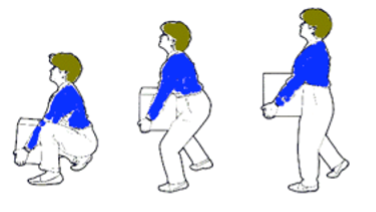
1. Size up the load before you lift. Test by lifting one of the corners or pushing. If it is heavy or feels too clumsy, get a mechanical aid or help from another worker. When in doubt, do not lift alone! GET HELP.
2. BEND THE KNEES. You will note this is capitalized. There is a reason for that: it is the single most important aspect of lifting.
3. When performing the lift:
-
-
- Get as close to the object as possible.
- Place your feet close to the object and center yourself over the load.
- Get a good hand hold.
- Lift straight up smoothly and let your legs do the work, not your back.
-
-
-
- Avoid overreaching or stretching to pick up or set down a load.
- Do not twist or turn your body once you have made the lift.
-
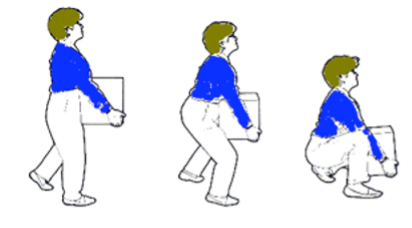
4. Make sure you have a clear path to carry the load.
5. Set the load down BEND KNEES AND NOT YOUR BACK.
Other Safe Lift information
Pushing vs. Pulling Objects: Always push, not pull, the object when possible. Change the lifting situation if possible to minimize a lifting hazard. If it is a long load, get help. Split the load into several smaller ones, when you can, to achieve manageable lifting weight.
Avoiding lifts from below the knees or above the shoulders by using mechanical aids, positioning yourself so that the object to move is within an acceptable lifting range (between the shoulders and knees), and/or getting help from your co-workers.
Alternative Materials-Handling Techniques
Alternative materials-handling techniques for carrying or moving loads are to be used whenever possible to minimize lifting and bending requirements. These alternative materials-handling techniques include use of:
- Hoists
- Forklifts
- Dollies
- Carts, and
- Other mechanical devices.
Other Safe Work Techniques
Work issues other than lifting are related to back pain or injury. You can avoid them or improve work techniques related to them.
Catching Objects & Working Low
When catching falling or tossed objects, your feet should be firmly planted, with your back straight and your knees slightly bent. Your legs should absorb the impact, not your back. If you're working on something low, bend your knees. Keep your back as straight as possible. Bending from the waist can lead to back pain. If you have to use your back, keep your knees bent and your back flat. In both of these situations, frequent rest breaks are necessary to keep from getting back fatigue.
Extended Sitting/Standing
Certain jobs require long hours of standing or sitting. These conditions can create back troubles. Get up and stretch frequently if you are required to sit for long periods. If standing, ease the strain on your lower back by changing foot positions often, placing one foot on a rail or ledge. However, keep your weight evenly balanced when standing. Don't lean to one side.
Other Materials Handling Tasks
Tasks such as lowering, pushing, pulling, and carrying can create hazards to the back as well. If the task feels uncomfortable or unnatural, utilize the alternative materials-handling techniques listed in this Back Safety Plan.
Housekeeping
Poor housekeeping means slippery floors, crowded work conditions, tools or other hazards on the floor. These can create slip, trip or fall hazards that can result in back injury.
Poor Posture at Work
Be aware of proper posture when sitting, standing, or reclining. When sitting, your knees should be slightly higher than your hips and your shoulders and upper back should be straight. When lying down or sleeping, keep your knees slightly bent. Sleeping on your stomach can lead to morning backache.
Other Back Safety Issues
Factors unrelated to work that can affect back safety, including such things as physical condition and posture, athletic or home-improvement activity, and tension and stress.
Posture
Whether you're standing, sitting, or reclining, posture affects the amount of strain put on your back. The wrong posture increases strain on the back muscles and may bend the spine into positions that will cause trouble. When standing correctly, the spine has a natural "S" curve. The shoulders are back and the "S" curve is directly over the pelvis. Good sitting posture should put your knees slightly higher than your hips. Your hips should be to the rear of the chair with your lower back not overly arched. Also, your shoulders and upper back are not rounded. Reclining posture is important, too. Sleep on your side with knees bent or sleep on your back. Sleeping on your stomach, especially on a sagging mattress with your head on a thick pillow, puts too much strain on the spine. Result: morning backache.
Poor Physical Condition
Your physical condition can lead to back pain. If you are overweight, and especially if you have developed a pot belly, extra strain on your spine results. An estimate is that every extra pound up front puts 10 pounds of strain on your back. When you are out of shape, the chances for chronic back pain are greater. Infrequent exercise is a major factor, too. A sudden strain on generally unused back muscle leads to trouble, particularly when there is a sudden twisting or turning of the back. Proper diet and exercise is the sensible way to help avoid back problems.
Stress
Stress is another factor that may lead to back pain. Tied in with your general physical condition, stress created from work or play can cause muscle spasms that affect the spinal nerve network. Although stress is part of everyone's life, and a certain amount of stress is normal, excessive stress causes backache. The solution is a balanced life style with time to relax.
Repetitive Trauma
People often think back injuries result from lifting heavy or awkward objects. Many back injuries, however, do not come from a single lift, but occur from relatively minor strains over time. Back injuries, as with other cumulative trauma disorders (CTD), may arise from repeated injuries. (But, repetitive, low-grade strains usually do not cause CTDs.) As the worker repeats a particular irritating movement, the minor injuries begin to accumulate and weaken affected muscles or ligaments. Eventually a more serious injury may occur. Thus, a specific weight lifted may actually have little to do with any single injury. Remember to use mechanical aids when appropriate along with good lifting techniques, whenever you do any lifting. You can lift safely when performed with caution.
Summary
Back safety awareness is necessary, due to the prevalence and severity of back injuries throughout business and industry. Sprains and strains are the most common causes of lower back pain. Backs can be injured by improper lifting, falling, auto accidents, and sports activities. But of these, lifting improperly is the largest single cause of back pain and injury. Instituting proper lifting techniques and other safety measures can significantly reduce your chance of a back injury incident.
Machine Guarding and Hand & Power Tools
Crushed hands and arms, severed fingers, blindness, etc. are part of a list of possible machinery related injuries. A good rule to remember is that any machine part, function or process which may cause injury must be safeguarded. When the operation of a machine or accidental contact with it can injure the operator or others in the vicinity, the hazards must be either controlled or eliminated.
Summary of Requirements
One or more methods of machine guarding shall be provided to protect the operator and other employees in the machine area from hazards such as those created by point of operation, nip points, rotating parts, flying chips and sparks. Examples of guarding methods are barrier guards, two-hand tripping devices, electronic safety devices, etc.
- Guards shall be affixed to the machine where possible and secured elsewhere if for any reason attachment to the machine is not The guard shall be such that it does not offer an accident hazard in itself.
- Whenever engineering controls are not available or are not fully capable of protecting the employee, operators must wear personal protective equipment.
Training
Specific and detailed training is a crucial part of any effort to provide safeguarding against machine related hazards. Thorough operator training should involve instructions or hands-on training in the following:
- A description and identification of the hazards associated with particular machines;
- the safeguards themselves, how they provide protection, and the hazards for which they are intended;
- how to use the safeguards and why;
- how and under what circumstances safeguards can be removed, and by whom; and
- what to do if a safeguard is damaged, missing or unable to provide adequate protection.
This kind of safety training is necessary for new operators and maintenance or setup personnel, when any new or altered safeguards are put in service, or when workers are assigned to a new machine or operation.
Inspections
All safeguards provided meet the minimum OSHA requirements.
- The safeguards are firmly secured and not easily removable.
- The safeguards prevent workers hands, arms and other body parts from making contact with dangerous moving parts.
- Special guards, enclosures or personal protective equipment have been provided, where necessary, to protect workers from exposure to harmful substances used in machine operations.
Safe Use of Hand Tools
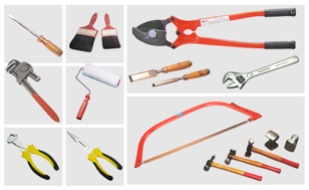
- Hand tools must be used only for the purpose for which they are designed (e.g., a screwdriver must not be used as a chisel).
- Before each day’s use, employees must inspect hand tools for damage and defects.
- Wooden handles on hammers must not be loose, splintered, or cracked.
- Wrenches must not have loose or sprung jaws.
- Impact tools such as chisels, wedges, or drift pins must not have mushroomed heads.
- Cutting tools must not be dull. Dull tools can be more hazardous than sharp ones.
- Damaged or defective hand tools must be immediately tagged out (e.g., Unsafe— Do Not Use) and withdrawn from service for repair or replacement.
- Employees must not carry sharp tools in pockets unless the tools are sheathed.
- When using cutting tools, employees must cut in the direction away from their body.
Safe Use of Power Tools
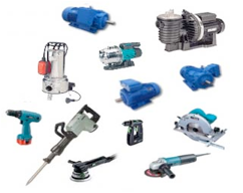
1. Portable cord-and-plug-connected power tools must be either grounded or double-insulated.
2. Employees must shut off and disconnect tools when not in use, before servicing, and when changing accessories such as blades, bits and cutters.
3. Guards and other safety devices must not be removed or defeated.
4. Employees must inspect portable cord-and-plug-connected power tools and extension cords before each day’s use for:
-
- Loose parts.
- Deformed and missing pins.
- Damaged insulation.
- Evidence of possible internal damage (e.g., pinched or crushed insulation).
- Broken or cracked cases.
5. Damaged or defective portable cord-and-plug-connected equipment must be immediately tagged out (e.g., Unsafe — Do Not Use) and withdrawn from service for repair or replacement.
DAMAGED OR DEFECTIVE POWER TOOLS ARE AN IMMINENT DANGER HAZARD AND MUST BE REMOVED FROM SERVICE IMMEDIATELY.
Repair of Cord-and-Plug Connected Equipment
Repairs to cord-and-plug-connected equipment must be performed by a qualified person and must provide the same insulation and sheath qualities as originally manufactured. Tape repairs are not acceptable.
Use of Extension Cords
- TEMPORARY USE ONLY – not a substitute for permanent wiring
- Only heavy-duty “SO” rated extension cords with a ground conductor may be used. Flat appliance-type extension cords are unsafe for workplace applications and must not be used.
- Extension cords must be approved and suitable for conditions of use.
- Extension cords must not be used as substitute for the fixed wiring of a structure or be:
- Run through holes in walls, ceilings, or floors.
- Run through doorways, windows, or similar openings except for short-term work where the extension cord is not subject to damage.
- Attached to building surfaces or fastened with staples or otherwise hung in such a fashion that could damage the outer jacket or insulation.
- Concealed behind building walls, ceilings, or floors.
- Flexible cords and cables must be protected from accidental damage.
- 6. Flexible cords must equipped with an attachment plug and must be energized from an approved receptacle outlet.
Continuity of Ground Conductor and Ground-Fault Circuit Interrupters (GFCIs)
- Employees must not use adapters (e.g., “cheater plugs”) that interrupt the continuity of the ground connection.
- Employees must connect power tools and similar equipment to a ground-fault circuit interrupter when working in wet or conductive environments.
Safe Use of Bench Grinders
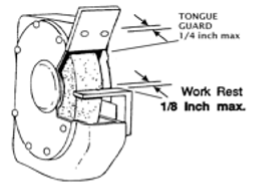
- Employees must shut off and disconnect bench grinders when changing a wheel or adjusting the work rest.
- Guards and other safety devices must not be removed or defeated.
UNGUARDED BENCH GRINDERS ARE AN IMMINENT DANGER HAZARD AND MUST BE REMOVED FROM THE WORK AREA IMMEDIATELY.
- Employees must inspect bench grinders before each day’s use. Employees should:
- Check the condition of the wheel.
- Be sure that shields and guards are in place and properly adjusted.
- Ensure that the work rest is adjusted to within 1/8 inch of the wheel.
- Ensure (if present) an adjustable tongue guard is not greater than 1/4 inch.
- Damaged or defective bench grinders must be immediately tagged out (e.g., Unsafe — Do Not Use) and withdrawn from service for repair.
- When using a bench grinder, employees must perform work from the wheel’s circumference.
Use of Compressed Air for Cleaning
- Employees must use approved nozzles that reduce air pressure to 30 psi or less.
- Employees must never use compressed air for personal cleaning.
Safe Use of Slings, Chains and Wire Ropes
- Employees must ensure that hoists, come-alongs, slings, chains and wire ropes are rated for the load to be lifted.
- Employees must inspect slings, chains and wire ropes for damage and defects before each use. Employees should check for:
- Corrosion.
- Excessive wear.
- A one-third reduction in outer wire diameter.
- Deformed links, hooks or eyelets.
- Distortion or kinking.
- Broken or frayed wires or the presence of exposed warning fibers.
- Damaged or defective slings, chains and wire ropes must be immediately tagged out (e.g., Unsafe — Do Not Use) and withdrawn from the work area for repair or disposal.
DAMAGED OR DEFECTIVE SLINGS, CHAINS AND WIRE ROPES ARE AN IMMINENT DANGER HAZARD AND MUST BE REMOVED FROM THE WORK AREA IMMEDIATELY.
Safe Practices for Lifting Loads with Slings, Chains and Wire Ropes
1. The hoist operator must secure the load properly by:
- Slings must not be shortened with knots, bolts or other makeshift devices.
- Protecting the sling(s), chain(s) or wire rope(s) with padding when necessary to prevent cutting or abrasion.
- Securing the load so that it is sufficiently supported and will be stable.
2. The hoist operator must lift the load safely by:
- Not placing their hands and fingers between the sling and its load while the sling is being tightened.
- Not allowing employees to ride loads.
- Lifting and moving the load Fast or jerky actions and shock loading must be avoided.
- Not standing directly below the load.
- Not moving the load over other people.
- Falling object hazard areas must be identified with signs, barricades or banner tape.
3. The hoist operator must set the load down safely by:
- Being sure personnel are clear.
- Setting the load down slowly and maintaining control.
- Not pulling a sling, chain or wire rope out from under a load when the load is resting on the sling, chain or wire rope.
Safe Use of Powered Grounds Care Equipment

- Powered grounds care equipment (e.g., push mowers, edgers and trimmers) may only be operated by appropriately trained employees.
- Operators must inspect powered grounds care equipment before each day’s use for faulty or missing parts, especially guards and other safety devices.
- Operators must disengage all mechanical equipment, shut off the engine, and remove the wire from the spark plug (if not equipped with an ignition key) when powered grounds care equipment is being inspected, cleaned or serviced.
- Operators must never clear the discharge chute or otherwise place their hands near the blades or cutters of operating equipment.
- Damaged or defective power grounds care equipment must be immediately tagged out (e.g., Unsafe — Do Not Use) and withdrawn from service for repair.
MISSING OR DEFECTIVE SAFETY DEVICES EXPOSE GROUNDS CARE EQUIPMENT OPERATORS TO IMMINENT DANGER. DEFECTIVE EQUIPMENT MUST BE REMOVED FROM SERVICE IMMEDIATELY
6. When refueling, operators must turn off the engine and wipe or allow any spilled fuel to evaporate before the engine is restarted.
7. Powered grounds care equipment that is not in use or that is left unattended must be turned off.
8. Guards and other safety devices must not be removed or defeated.
9. Operators must maintain powered grounds care equipment in a clean condition, free of excess oil and grease.
- Non combustible agents should be used for Low flash point solvents must not be used.
10. When starting powered grounds care equipment, operators must place the equipment on a secure surface and keep their hands and feet clear of moving blades and cutters.
11. When operating powered grounds care equipment, operators must:
- Hold the equipment firmly with both hands placed on the equipment’s designated handholds.
- Ensure that their feet and hands are clear of moving blades and cutters, especially when the equipment is being pulled towards the operator.
- Be alert for the presence and location of other persons.
- Operators must instruct other persons to remain at a safe distance.
- Immediately shut off the equipment if a mechanical problem develops.
Electrical Safety
Background
ELECTRIC SHOCK
It is well known that the human body will conduct electricity, and that if direct contact is made with an electrically energized part while a similar contact is made simultaneously with another conductive surface which is maintained at a different electrical potential, a current will flow, entering the body at one contact point and exiting at another contact point, usually the ground.
Each year, many workers suffer pain, injuries, and death from such electric shocks. OSHA estimates that there are more than 300 electrical fatalities in general industry each year. Burns and "secondary" injuries from collisions and falls are also of concern when working with electricity.
NATURE OF ELECTRICAL ACCIDENTS
Electrical accidents, when studied, often appear to be caused by circumstances which are varied and peculiar to the incidents involved. However, further consideration usually reveals the underlying cause to be a combination of three possible factors: an unsafe environment, unsafe equipment, and unsafe acts. It should also be noted that inadequate maintenance can cause equipment or installations which were originally considered safe to deteriorate, resulting in an unsafe condition.
PROTECTIVE MEASURES
There are various ways of protecting employees from the hazards of electric shock, including insulation and guarding of live parts. Insulation provides an electrical barrier to the flow of current. To be effective, the insulation must be appropriate for the voltage and the insulating material must be undamaged. Equipment grounding is another method of protection from electric shock.
However, even though equipment may be in compliance with installation requirements, personnel may still be exposed to electrical hazards. for example, an employee carrying a ladder could approach exposed live parts guarded by an installation beyond normal reaching distance. The employee's bringing the ladder close to the live parts exposes the worker to hazards greater than those present under usual working conditions.
Another important safety practice involves the use of electrical protective devices, such as rubber gloves and rubber mats for the purpose of insulation against live parts, or live-line tools for purposes of both insulation and manipulation of energized parts from a distance. Regular maintenance of such material is an important consideration in order to keep this equipment from deteriorating into an unsafe condition.
PROCEDURES
Procedures outlined in this program are supplemental, and therefore do not supersede any national, state, and local codes, laws, or regulations.
GENERAL
Live parts to which an employee or student may be exposed shall be de-energized before work is performed on or near them. In certain specific, rare incidents, de-energizing introduces additional or increased hazards or is infeasible due to equipment design or operational limitations. Such cases include, but are not limited to, shutdown of hazardous location ventilation equipment or removal of illumination for a critical area. Such exceptions shall be approved by the Manager Plant Services.
If the exposed live parts are not de-energized (for reasons of increased or additional hazards or infeasibility), then other safety-related work practices shall be used to protect employees who may be exposed to the electrical hazards involved. Such work practices shall protect employees against contact with energized circuit parts directly with any part of their body or indirectly through some other conductive object.
DE-ENERGIZING CIRCUITS
Conductors and parts of electric equipment that have been de-energized but have not been locked out or tagged out shall be treated as energized parts.
While any employee is exposed to contact with parts of fixed electric equipment or circuits which have been de-energized, the circuits energizing the parts shall be locked out or tagged or both.
Circuits and equipment to be worked on shall be disconnected from all electric energy sources. Control circuit devices, such as push buttons, selector switches, and interlocks, may not be used as the sole means for de-energizing circuits or equipment. Interlocks for electric equipment may not be used as a substitute for lockout/tagout.
Stored electrical energy which might endanger personnel shall be released. Capacitors shall be discharged and high capacitance elements shall be short-circuited and grounded, if the stored electrical energy might endanger personnel.
APPLICATION OF TAGS AND LOCKS
A lock and a tag shall be placed on each disconnecting means used to de-energize circuits and equipment on which work is to be performed, except as provided later in this document. The lock shall be attached so as to prevent persons from operating the disconnecting means unless they resort to undue force or the use of tools.
Each person applying a lock will have his/her own unique lock and key. Opening of an person’s
lock under certain circumstances may entail calling the individual back to the campus.
Each tag shall contain a statement prohibiting unauthorized operation of the disconnecting means and removal of the tag.
If a lock cannot be applied, or if it can be demonstrated that tagging procedures will provide safety equivalent to that of a lock, a tag may be used without a lock. In such cases, the following additional requirements shall be met:
The tags shall be of a distinctive, standardized design that clearly prohibits unauthorized energizing of the circuits and removal of the tag.
A tag may not be used without an additional safety measure such as the removal of an isolating circuit element, blocking of a controlling switch, or opening of an extra disconnecting device, or removal of wires from supply at the source.
All persons who have access to controlling devices shall be trained in and familiar with tagging procedures.
A lock may be placed without a tag only under the following conditions: Only one circuit or piece of equipment is de-energized
AND
The lockout period does not extend beyond the work shift AND
Affected employees are familiar with this procedure
Verification of the de-energized condition is vital. A qualified person shall operate the equipment operating controls or otherwise verify that the equipment cannot be started. A qualified person shall verify that the circuit elements and equipment parts are de-energized. A determination shall also be made for inadvertently induced or unrelated voltage "back feed" which can be introduced into the circuit. Shop supervisors will determine qualifications.
RE-ENERGIZING EQUIPMENT
Prior to re-energizing equipment, a qualified person shall conduct tests and visual inspections, as necessary, to verify that all tools, electrical jumpers, shorts, grounds, and other such devices have been removed so that the circuits and equipment can be safely re-energized. All affected employees shall be notified to stay clear of circuits and equipment. Locks and tags can then be removed after a final visual inspection has been made.
WORKING ON OR NEAR ENERGIZED PARTS
In the case of certain rare and specific instances when employees must work on energized equipment, only qualified individuals may perform such work. These persons must be familiar with the proper use of special precautionary techniques, personal protective equipment, insulating and shielding materials, and insulated tools.
OVERHEAD LINES

If work is to be performed near overhead lines, the lines shall be de-energized and grounded, or other protective measures shall be taken before work is started. If the lines shall be de-energized, arrangements shall be made with the person or organization that operates or controls the electric circuits involved to de-energize and ground them. If protective measures are provided such as guarding, isolating, or insulating, these precautions shall prevent employees from contacting such lines directly with any part of their body or indirectly through conductive materials, tools or equipment.
When an unqualified person is working in an elevated position near overhead lines, the location shall be such that the person and the longest conductive object he or she may contact cannot come closer to any unguarded, energized overhead line than the following distances:
For voltages to ground 50 kV or below: 10 feet
For voltages to ground over 50 kV: 10 feet plus 4 inches for every 10 kV over 50 kV
When a qualified person is working in the vicinity of overhead lines, whether in an elevated position or on the ground, the person may not approach or take any conductive object without an approved insulating handle closer to exposed energized parts than shown in the table below unless:
The person is insulated from the energized part (gloves, etc.).
The energized part is insulated from any other conductive object at a different potential and from the person.
The person is insulated from all conductive objects at a potential different from the energized part.
ALTERNATING CURRENT APPROACH DISTANCES
|
Voltage range |
Maximum approach distance |
|
300V and less |
Avoid contact |
|
Over 300V, not over 750V |
1 ft. 0 in. |
|
over 750V not over 2kV |
1 ft. 6 in. |
|
Over 2kV, not over 15kV |
2 ft. 0 in. |
|
Over 15kV, not over 37kV |
3 ft. 0 in. |
|
Over 37kV, not over 87.5kV |
3 ft. 6 in. |
|
Over 87.5kV, not over 121kV . |
4 ft. 0 in |
|
Over 121kV, not over 140kV |
4 ft. 6 in. |
VEHICULAR AND MECHANICAL EQUIPMENT
Any vehicle or mechanical equipment capable of having parts of its structure elevated near energized overhead lines shall be operated so that a clearance of 10 feet is maintained. If the voltage is higher than 50kV, the clearance shall be increased 4 inches for every 10kV over that voltage. However, under any of the following conditions, the clearance may be reduced:
- If the vehicle is in transit with its structure lowered, the clearance may be reduced to 4 feet.
- If insulating barriers are installed to prevent contact with the lines, and if the barriers are rated for the voltage of the line being guarded and are not a part of or an attachment to the vehicle or its structure, the clearance may be reduced to a distance within the designed working dimensions of the insulating barrier.
- If the equipment is an aerial lift insulated for the voltage involved, and if the work is performed by a qualified person, the clearance may be reduced to the distance given in the above table.
Employees standing on the ground may not contact the vehicle or mechanical equipment or any of its attachments, unless the employee is using protective equipment rated for the voltage.
If any vehicle or mechanical equipment capable of having parts of its structure elevated near energized overhead lines is intentionally grounded, employees working on the ground near the point of grounding may not stand at the grounding location whenever there is a possibility of overhead line contact. Additional precautions, such as the use of barricades or insulation, shall be taken to protect employees from hazardous ground potentials, depending on earth resistance and fault currents.
ILLUMINATION
Employees may not enter spaces containing exposed energized parts, unless illumination is provided to enable the employees to perform the work safely.
Where lack of illumination or an obstruction precludes observation of the work to be performed employees may not perform tasks near exposed energized parts.
Employees may not reach blindly into areas which may contain energized parts.
CONFINED OR ENCLOSED WORK SPACES
When working in confined or enclosed spaces (such as manholes or vaults) that contain energized parts, employees shall take precautions (such as the use of protective shields, barriers, or insulating materials) to avoid inadvertent contact with these parts. Doors, hinged panels and the like shall be secured to prevent their swing into an employee and causing the employee to contact exposed energized parts.
The above precautions are supplemental to any and all other guidelines for working in confined spaces such as those regarding the use of respiratory protection. Refer to the College's Confined Space Entry Procedures.
CONDUCTIVE MATERIALS
Conductive materials and equipment that are in contact with any part of an employee's body shall be handled in a manner that will prevent them from contacting exposed energized conductors or circuit parts. If employees handle long dimensional conductive objects such as ducts and pipes in areas with exposed live parts, supervisors will minimize the hazards.
PORTABLE LADDERS
Portable metal ladders and ladders with longitudinal metallic reinforcement may not be used wherever employees might contact exposed energized parts.
CONDUCTIVE APPAREL
Conductive articles of jewelry and clothing (such as watch bands, bracelets, rings, key chains, necklaces, metal headgear, etc.) may not be worn if they might contact exposed energized parts. The contact hazard may be eliminated if such articles are rendered nonconductive by covering, wrapping, or other insulating means.
HOUSEKEEPING
"Housekeeping" duties involving conductive cleaning materials (including conductive solids such as steel wool and metalized cloth as well as conductive liquid solutions) shall not be used in the proximity of energized parts unless procedures are followed which will prevent electrical contact.
PORTABLE ELECTRICAL EQUIPMENT
Portable equipment shall be handled in a manner which will not cause damage. Flexible electric cords connected to equipment may not be used for raising or lowering the equipment. Flexible cords may not be fastened with staples or otherwise hung in such a fashion as to damage the outer jacket or insulation.
Portable cord- and plug-connected equipment and flexible cord sets (extension cords) shall be visually inspected before use for external defects such as loose parts, deformed and missing pins, or damage to the outer insulation). If there is a defect or evidence of damage that might expose an employee to injury, no employee may use the defective or damaged item until necessary repairs and tests have been made.
Attachment plugs and receptacles may not be connected or altered in a manner which would prevent proper continuity of the equipment grounding conductor at the point where plugs are attached to receptacles. Additionally, these devices may not be altered to allow the grounding pole of a plug to be inserted into slots intended for connection to the current-carrying conductors.
Adapters which interrupt the continuity of the equipment grounding connection may not be used.
Portable electric equipment and flexible cords used in highly conductive work locations, such as those inundated with water or other conductive liquids, or in job locations where employees are likely to contact water or conductive liquids, shall be approved for those locations. Ground fault protection shall also be provided.
Employees' hands may not be wet when plugging and unplugging flexible cords and associated equipment.
RE-CLOSING CIRCUITS
After a circuit is de-energized by a circuit protective device, the circuit may not be manually re-energized until it has been determined that the equipment and circuit can be safely re-energized. The repetitive manual re-closing of circuit breakers or re-energizing circuits through replaced fuses is prohibited.
PERSONAL PROTECTIVE EQUIPMENT
Employees working in areas where there are potential electrical hazards shall be provided with electrical protective equipment that is appropriate for the specific parts of the body to be protected and for the work to be performed. Protective equipment shall be maintained in a safe, reliable condition and shall be periodically inspected or tested. Employees shall wear nonconductive head protection wherever there is a danger of head injury from electric shock or burns due to contact with exposed energized parts. Employees shall wear protective equipment for the eyes or face wherever there is a danger of injury to the eyes or face from electric arcs or flashes or from flying objects resulting from electrical explosion.
Fuse handling equipment, ropes, hand lines protective shields, protective barriers, and insulated tools shall be used when appropriate to protect employees from exposed energized parts.
ALERTING TECHNIQUES
Safety signs, safety symbols, or accident prevention tags shall be used where necessary to warn personnel about electrical hazards which may endanger them. Barricades shall be used in conjunction with safety signs where it is necessary to prevent or limit employee access to work areas exposing individuals to un-insulated energized circuit parts. Conductive barricades may not be used. If signs and barricades do not provide sufficient warning and protection from electrical hazards, an attendant shall be stationed to warn and protect employees.
Personal Protective Equipment (PPE Guide)
Under OSHA's general requirements for Personal Protective Equipment (PPE), the University shall perform a hazard assessment of the work site. This hazard assessment is to determine if PPE is necessary; select the appropriate protective equipment; train employees to use it properly; and ensure that they wear it. This is a condensed web version of the actual SUNY New Paltz Policy and Program.
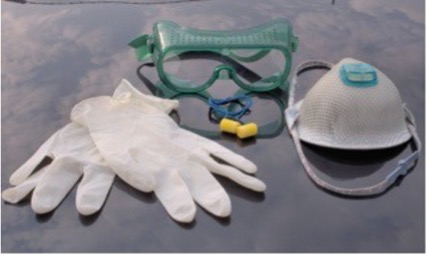
You should know how to use, maintain and wear the appropriate protective equipment.
Summary of Requirements
- Protective equipment, including personal protective equipment for eyes, face, head and extremities, protective clothing, respiratory devices, and protective shields and barriers, shall be provided, used, and maintained in a sanitary and reliable condition wherever it is necessary by reason of hazards of processes or environment, chemical hazards, radiological hazards, or mechanical irritants encountered in a manner capable of causing injury or impairment in the function of any part of the body through absorption, inhalation or physical contact.
- Employee-owned equipment: Where employees provide their own protective equipment, the employer shall be responsible to assure its adequacy, including proper maintenance, and sanitation of such equipment.
- Design: All personal protective equipment shall be of safe design and construction for the work to be performed.
- Hazard assessment: The employer shall assess the workplace to determine if hazards are present, or likely to be present, which necessitate the use of personal protective equipment.
Note: when your PPE hazard assessment calls for sturdy work shoes a sturdy work shoe is defined as leather or appropriate material footwear with proper foot support, protection, and grip for tasks. Flat sole canvas sneakers, moccasins, open toed shoes would not be deem appropriate sturdy work shoes.
Training
The supervisor of the employee shall provide training to each employee who is required by this section to use PPE. Each such employee shall be trained to know at least the following:
- When PPE is necessary.
- What PPE is necessary.
- How to properly put on, take off, adjust, and wear PPE.
- The limitations of the PPE.
- The proper care, maintenance, useful life and disposal of PPE.
Reporting
The supervisor of employee shall verify:
- That the required workplace hazard assessment has been performed through a written certification that identifies the workplace evaluated.
- That a person has certified that the evaluation has been performed.
- That the hazard assessment has been signed and dated identifies the document as a certification of hazard assessment.
Inspections
PPE should be inspected, cleaned, and maintained at regular intervals by employee so that the PPE provides the requisite protection.
Recordkeeping
The Hazard Assessment forms must be signed by the supervisor to certify that this process has been performed as required by the regulation. The forms must be maintained with the departmental records.
Portable Ladder Safety
The purpose of these procedures is to provide guidance and to promote the safe use of portable ladders for the SUNY New Paltz employees. The goal of this policy is to provide adequate knowledge and training to minimize or eliminate ladder accidents.
INTRODUCTION
Excluding motor vehicle accidents, falls are the number one cause of occupational related deaths. The Occupational Safety and Health Administration (OSHA) estimates that 18,757 injuries and 24 fatalities per year are caused by falls from ladders annually.
Ladder mishaps result from several unsafe acts and conditions:
-Ladders placed on unstable surfaces.
-Workers on ladders reaching too far beyond the sides of the ladder. (Beyond the center of the body)
-Personnel standing too high on the ladder in order to maintain balance.
-Defective or broken ladders (e.g., broken rails, rungs, missing hardware).
-Ladders that were not secured or braced. (Particularly extrusion ladders.)
-Personnel hand carrying loads while ascending or descending.
-Selecting the wrong ladder for the job.
-Improper positioning of the ladder.
-Eighty percent of ladder fall victims fell or slipped and nearly half of these fell at least 8 feet.
-Fifty-seven percent of fall victims were holding object(s) with one or both hands.
-Sixty-six percent of fall victims were not trained in how to inspect ladders.
-Seventy-three percent of fall victims were not provided written instructions on the safe use of ladders.
-Thirty percent of fall victims had wet, greasy or oily shoes.
Responsibilities
Role of EH&S office
The role of Environmental Health and Safety (EH&S) is to assist the various departments and other administrative units in complying with the applicable regulations and this ladder policy. In order to ensure compliance with this policy the EH&S office shall conduct routine inspections/audits.
EH&S will assist in providing any additional ladder safety training.
Role of Supervisors of employees who use ladders
Ensure employees read and understand the material in this program document. Ensure employees are complying with program elements by periodic reviews of job activities when ladders are in use or storage.
Role of the employee
Follow the ladder safety program elements from use to storage. Inspect the ladder prior to use as outlined in this document. Do Not Use broken or defective ladders; remove from service for repair or disposal. Read this program at least annually.
WORK PRACTICE
Portable ladders can be carried or pushed from place to place. Portable ladders can be made from metal (mostly steel or aluminum), wood, fiberglass, or reinforced plastic.
If a safer means of access (e.g., scaffolds, work platforms, or fixed ladders with safety devices) is possible, portable ladders should not be used. In many cases, the task determines the correct ladder required for the job. (For example: Indoor painting usually requires a conventional stepladder, while outdoor painting requires extension ladders. A heavier job may require an "upgraded" ladder, such as a platform ladder.) Portable ladder types can be subdivided for different jobs. These ladders include:
- single or straight in line sequence ladders, stepladders
- extension (Not all ladders are suitable for all jobs.) The ladder that just happens to be available may not only be wrong, but also dangerously unsafe for the specific job.
Ladder Safety Training -Proper ladder safety training consists of a number of common sense factors which include selection of the proper portable ladder for each job, considering:
- Height of the Ladder
Ladders must be long enough to insure that the user does not stand on the top two steps of a stepladder or the top four rungs of a straight ladder. When an extension ladder is used to access a roof, the ladder should extend at least 3 feet above the support point at the eave, gutter, or roof line. Short ladders should never be spliced together to form a longer ladder. Ladders should not be placed on boxes, barrels, or any other unstable bases to gain additional height.
- The Weight Capacity (or working load)
Ladders are constructed to safely hold a specific amount of weight. These weight limits consist of users, their clothing, tools, and materials. Extra allowance should be made for stress exerted by the worker while performing the job. The heavy-duty ladder is best suited for industrial use because it holds up against frequent and rigorous demands.
The weight-capacity classifications for ladders are as follows:
|
GRADE |
Duty |
Rating (1lb)(kg) |
USE |
|
Household |
III |
200 (91) |
Household |
|
Commercial |
II |
225 (102) |
Tradesman |
|
Industrial |
I |
250 (114) |
Industrial |
|
Heavy-duty Industrial |
IA |
300(136) |
Heavy Industrial |
Training requirement- employees who use ladders on the SUNY New Paltz must read and understand the requirements of the program. The refresher training is annually.
*EVERY LADDER'S DUTY RATING IS DISPLAYED BY A LABEL AFFIXED TO THE LADDER.
Inspection
SUNY New Paltz employees who utilize ladders are required to inspect ladders before using. They should look for loose, broken, or missing rungs, steps, cleats or side rails; missing safety feet, frayed ropes, and other defective parts. All rungs should be free from oil, grease, or other slippery substances. Rungs or steps on metal ladders should be skid resistant (through corrugating, knurling, dimpling or coating). Movable parts must function freely. Metal bearings should be well oiled. (See the self-assessment section for a list of ladder requirements.) Damaged ladders should not be used and, after labeling, should be either repaired or destroyed. The labels should read "Condemned--Do Not Use."
PRECAUTIONS
The following general safety precautions shall be done:
- Avoid using a ladder if you are excessively tired, on medication, or have been temporarily impaired.
- Place the ladder angle so that the base is at least 1 foot (0.305 meter) out for each 4 feet (1.2 meter) of ladder working length (support point to the base). Example: 12'=3', 20'=5'.
- Place the top of the ladder so that both rails are fully Allow extra room in case of ladder shifting.
- Place the ladder on a substantial and level base, staking or securing the lower end of the ladder, whenever The top support point for portable ladders must be rigid and have adequate strength to support the applied load.
- Place the ladder away from unlocked or unguarded doors that may open toward the ladder.
- Extend the ladder side rails at least 3 feet (0.91 meters) above the support point.
- Always raise extension ladders so that the upper section overlaps and rests on the bottom The upper section must always overlap on the climbing side of the extension ladder. Make sure that there is at least a 3 foot (0.91 meters) overlap for extension ladders of 36 feet (11 meters) or more.
- Do not place a metal or metal-reinforced ladder where it may come in contact with electric wiring.
- Use a non conductive ladder when working near live energized electric.
- Never use ladders in a horizontal position.
- Take care when ladders are used on oily, metal, concrete, or slippery surfaces.
- Extend the ladder only while standing on the ground at the ladder base.
- Do not place ladders on boxes, barrels, or other unstable bases to obtain additional height.
- Do not use ladders to gain access to a roof unless the top of the ladder extends at least 3 feet (0.91 meters) above the support point (at roof line).
CLIMBING (GENERAL PRECAUTIONS)
- Face the ladder and use both hands to grip the side rails while ascending or descending.
- Only one person at a time should stand on portable ladders
- Carry tools on a tool Haul materials up on a line, rather than carrying them.
- Do not exceed the maximum safe height limit (fourth rung from the top on extension ladders; second step from the top on stepladders).
- Wipe off greasy or muddy shoes, as much as possible, before using the ladder.
- Do not overload a ladder.
OTHER REQUIREMENTS
- Be sure that a stepladder is fully open and locked before you use it.
- Do not leave placed ladders They may be a hazard for others.
- Keep ladders clean and free of grease.
- Use extra caution while climbing during windy weather conditions.
- Never use a defective ladder.
- Do not drop or throw ladders.
- Do not use make-shift ladders.
- Do not splice short ladders together to make long ladders.
- Make sure portable ladders have non-slip feet.
- Handle ladders with care. Do not drop or misuse them.
REPAIRS
Field or makeshift repairs on existing ladders or the fabrication of ladders is not allowed. The ladder must be taken out of service immediately. Do not attempt to straighten or use a bent ladder made of metal or reinforced plastic. Ladder repairs must be made only by ladder mfg or qualified personnel.
STORAGE OF LADDERS
Store ladders in a manner that provides easy access for inspection and permits safe withdrawal for use. Ladders must not be stored where they present a tripping hazard, or where they can fall on personnel. When stored horizontally, ladders should be supported at several points to avoid sagging. The ladders should be kept away from sources of heat and moisture and in a well-ventilated area. Aluminum ladders should not be stored in certain atmospheres (e.g., acidic) due to severe corrosion problems. Ultraviolet rays of the sun can cause deterioration in fiber-glass ladders. Wax fiber-glass ladders with paste wax for extended storage and increased life span of use.
TRANSPORTATION
Assistance may be needed in transporting heavy or long ladders. When transported on vehicles, ladders should be adequately supported (preferably on hardwood or rubber-covered pipe) to avoid sagging and should be fastened securely.
HAZARDS
Most ladder mishaps result in falls which are sometimes fatal. Electrical shock can occur if the user is working with electrical equipment while standing on a conductive metal ladder. Portable metal ladders must always have warning labels affixed to the ladder.
Some of the various hazards are summarized below.
|
HAZARD |
HELPFUL HINT |
|
Personnel slipping |
Remove grease, oil, and mud from shoes. Avoid overreaching. Do not climb past SAFE height. Watch your step. |
|
Ladder movement |
Secure base and top of ladder. Use nonskid feet. Set the ladder at the proper 4:1 angle. Avoid slippery surfaces. |
|
Ladder breakup |
Inspect all ladders before using. |
|
Electrical shock |
Use nonmetal ladders around electricity. |
|
Environmental conditions |
Use extra caution in climbing on windy days. Avoid climbing during storms. |
|
Pinching (Body parts caught between moving parts in closing ladder.) |
Use gloves where required. Use caution in closing ladder. |
This web policy is provided to ladder users on the SUNY New Paltz as a guide and a reminder of safe ladder use and procedures. Safe use of ladders, however, is always the responsibility of the individual users. Employees must read and understand the requirements of ladder usage at the SUNY New Paltz.