


DEPARTMENT OF THEATRE ARTS PRODUCTION HANDBOOK
All faculty, students, and staff in the Department of Theatre Arts have a responsibility to themselves and their department to promote and practice high safety standards. The following rules and guidelines are intended to promote a safe and healthy environment.
PRODUCTION HANDBOOK
Please see the SUNY New Paltz Office of Enviromental Health and Safety's General Safety Rules to review safety standards that apply to all University employees.
Departmental Productions
In partnership with the curricular offerings, the Department of Theatre Arts at SUNY New Paltz produces a series of productions during the academic year. These productions serve as experiential opportunities for students and include majors, non-majors, faculty, and, at times, guest artists. Typically, the season consists of two fully supported productions, one Student Explorations in Theatre (S.E.T.) production, and one S.E.T. reading each semester. Often, productions take place in both McKenna Theatre and Parker Theatre. The schedule of the season follows guidelines described in this document but is reliant on the academic schedule of the University and the capacity of the students, faculty, and facilities.
Production Season Mission Statement
Consistent with the mission of the Department, the Production Season “is dedicated to engaging New Paltz students in a dynamic, experiential, and diverse educational experience”. Additionally, the season serves as a laboratory for students “applying theatre practices and developing various techniques, skills and methods for creating works of live performance.”
The Season is also a way to engage the campus and local community and while we often use the theatre as a place to entertain, it also provides an opportunity to challenge ourselves as artists and audiences with stories that resonate within the community.
Content coming soon.
Content coming soon.
Production Assignments
Duties and responsibilities for all positions include but are not limited to those listed in the following sections. Students with production assignments work under the supervision of the pertinent faculty.
Student Directors, designers, and technicians will be selected by the faculty members of the respective area. Student assignments will be based on the educational needs and proficiency levels of the students along with the technical needs of the production. Assignment of Stage Managers will be made in consultation with the Director. All production assignments must be approved for academic eligibility by the Producer.
Click the title of any section to expand and read full responsibilities of each production assignment. Click the title again to collapse the information.
Student Production Assignments: Leadership and Design (R&P)
Assistant Director +
Supervised by: Director
The Assistant Director (AD) helps the Director with the tasks of scheduling, research, rehearsals, casting, and more. The specific duties of the AD are set by the Director and may include the following.
Duties and Responsibilities:
- Attend all design and production meetings.
- Attend all auditions and rehearsals including technical rehearsals.
- Take notes as needed/outlined by the Director.
- Assist with running lines with Actors.
- Assist with running understudy rehearsals if needed.
- Perform administrative duties as needed/outlined by the Director.
- Refer to the duties of the Director above.
- Adhere to the rehearsal rules as outlined in the Rehearsal Guidelines section.
- Familiarity with the rehearsal protocol as outlined in the Production Handbook.
Production Stage Manager +
Supervised by: Production Manager and Faculty Advisor
Supervises: Assistant Stage Manager and Production Assistant
The Production Stage Manager is the lead Stage Manager for the production. In coordination with the Production Manager, the Production Stage Manager is the primary conduit of communication with all production departments in order to create an informed and well-run production from the first design meetings to closing night. The Production Stage Manager must be organized, efficient, familiar with and adhere to the rules of the Production Handbook. The Production Stage Manager should maintain a professional demeanor at all times and is supervised by the Production Manager and/or the stage management faculty advisor.
Duties and Responsibilities:
- Communicate all relevant production information found, created or otherwise acquired with the appropriate members of the creative and production teams.
- Attend all design and production meetings.
- Assist with the set up and management of auditions with assistance and coordination with the stage management faculty advisor.
- Coordinate and maintain the rehearsal and technical schedules with the Production Manager, faculty advisor and Director.
- Schedule and run production meetings in coordination with the Production Manager.
- Create and maintain call-board for the production as outlined in Rehearsal Guidelines Section.
- Facilitate all rehearsals including call times and breaks.
- Adhere to the rehearsal rules as outlined in Rehearsal Guidelines Section.
- Assemble and maintain the Prompt Book which is defined as the accurate playing text and stage business, together with such cue sheets and plots as are necessary for the actual technical and artistic operation of the production.
- Establish a check out list of scripts/librettos (in the case of a musical) and distribute to cast. On closing day, licensed librettos are collected for return to the licensing house – librettos are returned to the stage management faculty supervisor.
- Create and distribute daily Rehearsal and or Performance Reports to the artistic and production staff.
- Coordinate and manage rehearsal props with the Prop Supervisor.
- Assist and coordinate with management of rehearsal costumes.
- Establish and maintain headset protocol with Assistant Stage Managers and Run Crew.
- Work with House Management to coordinate management of audience for timely start of performances and intermissions.
- Coordinate, supervise and delegate to Assistant Stage Managers and Production Assistants rehearsal and production duties as well as rotation of creation of Rehearsal and Performance Reports. Rehearsal and Performance Reports should be proofed by the PSM prior to distribution.
- Generate in coordination with Assistant Stage Managers and Production Assistants checklists of duties for rehearsal set up and performance deck preparation.
- Supervise all members of the Run Crew as established in production meetings and technical rehearsals.
- Run all performances with consistency and professionalism.
Stage Management, Personal Technology Devices/Social Media:
While all members of the production (cast and crew) are expected to refrain from the use of personal technology devices and refrain from engaging in social media during rehearsals and performances (not including breaks), Stage Management is may use laptops (personal or provided by the Theatre Arts Department) during rehearsals and performances for production purposes ONLY.
Due to the efficiency texting provides in contacting faculty and/or other stage management personnel in unusual or emergency circumstances, Stage Management is permitted to have their phones on (silent) and active for production purposes ONLY while on call.
When in preparation for rehearsal or performances (ex. sweeping and mopping/pre-setting props and set pieces) for safety purposes, stage management must refrain from using earphones of any kind.
Please refer to the policy on photography and social media in the Rehearsal Guidelines Section.
Stage Management Work Attire:
- Closed toe shoes for both rehearsals and performance
- Hair tied back from the face
- No “dangling” earrings, necklaces or bracelets
- In previews and performance: black garments – pants and long sleeve shirts; no bold graphics – pants or belt to support clear com headset
- Mag light (if you do not have one, the Theatre Arts Department will provide one on loan for you)
- Multi-tool (if you do not have one, the Theatre Arts Department will provide one on loan for you)
Stage Manager +
Description coming soon.
Assistant Stage Manager +
Supervised by: Production Stage Manager, Production Manager, Faculty Advisor
The Assistant Stage Manager assists the Production Stage Manager in the execution of their duties as outlined above. The Assistant Stage Manager is supervised by the Production Manager and/or the stage management faculty advisor. The delegation of the duties of the Assistant Stage Manager should be determined prior to the audition process.
Duties and Responsibilities:
- Attend all auditions and rehearsals.
- Attend all design and production meetings where possible.
- Assist in preset of the stage for rehearsal and performances.
- Assist in sweeping/mopping and general maintenance of rehearsal/performance space at each work call.
- Organize rehearsal props/set pieces.
- Restore prop/set pieces post rehearsals/performances to the dedicated, proper storage.
- Hold book for line calling and/or line notes.
- Stand in for Actors when understudies not available.
- Assist in the management of all backstage and dressing room activities before, during and after rehearsals, tech rehearsals and performances.
- Assist in supervising Actor/run crew calls.
- Assist in checking Actors for places and entrances.
- Assist in scenery/props shifts as needed.
- Alert Production Stage Manager immediately of any on or offstage emergencies.
- Maintain headset protocol as directed by the Production Stage Manager.
- Familiarity with the rehearsal protocol as outlined in the Production Handbook.
Assistant Production Manager +
Description coming soon.
Choreographer +
Supervises: Dance Captain
Choreographers work with dancers, cast members, the Music Director and the Director in order to interpret and develop ideas and transform them into the finished dance or stylized movement pieces for performances. This might mean producing a production or working under an artistic Director in a dance company, the Director of an opera, play or musical. They may also act as movement coaches for Actors as well as movement consultants for theatre productions.
Duties and Responsibilities:
- Auditions the dancers.
- Creation of original choreography - Plans each separate movement to fit the music and scene, act, period or style of the production.
- Teaches, and in cooperation with the Director, schedules dance rehearsal and oversees teaching the cast members how to execute the choreography and rehearses them. Also notates dance steps and formations (possibly using a notation system, such as Labanotation or Benesh), cleans dance combinations, teaches techniques and dance steps, and may run fitness conditioning or warm-ups within a rehearsal.
- When working with a Director, the Choreographer must contribute choreography consistent with the production’s style, including pacing.
- Must collaborate with the Musical Director (and Accompanist), Costume Designer, Set Designer and Lighting Designer, to make sure that all stage movement is compatible with musical cues, costuming, sets and lighting.
- Oversee all activities of the wardrobe crew.
- Sometimes movement is required as part of a scene or transition which the Choreographer can develop a sequence of movements to demonstrate.
Dramaturg +
Supervises: Assistant Dramaturg
The Dramaturg is an expert on the script of a production -- the cultural context in which it is created, the ideas and themes with which it is concerned, the background and historical relevance of the play and the technical aspects of playwriting at work in the text. Dramaturgs also can act as a liaison between Director and Playwright.
Duties and Responsibilities:
- Creating a dramaturgical protocol to support the work of the Director, Designers, and Actors.
- Helping the Director cut, shape, revise, or adapt a script where appropriate.
- Serving as an in-house critic of the production while in process.
- Write study guides for schools and other groups.
- Leads and organizes post-production discussions.
- Create lobby displays.
- Researches all productions for information useful in the rehearsal process and development of the program notes.
- Attends selected rehearsals and all production meetings.
Assistant Dramaturg +
Supervised by: Dramaturg
The Assistant Dramaturg is artistically concerned with supporting the Dramaturg’s process on a production.
Duties and Responsibilities:
- Aid the Dramaturg in the creation of the dramaturgical protocol, actor packet, study guide, lobby display and pre-and post-show discussions.
- Attend production meetings and rehearsals (exact schedule to be discussed with faculty supervisor and Dramaturg).
- Other show specific dramaturgy-related duties (as assigned by the Dramaturg in consultation with the faculty supervisor).
- Check-ins with the faculty supervisor.
Costume Designer +
Supervises: Assistant Costume Designer and Hair and Makeup Supervisor
The Costume Designer is responsible for the visual appearance of the Actors. The Costume Designer creates the look of the clothes for a production based on collaboration with the Director.
Duties and responsibilities:
- Reads script and determines the costume needs of the production.
- Research period details, fabric availability, and rental possibilities.
- Attend design meetings.
- Supply specifications for the supervision of making and painting of costumes, and the making of costume accessories.
- Create a designer’s “bible” which is a book that will include but not be limited to the following: Cast list, Action chart, Script Analysis, Costume plot/list, research collages, color palette, sketches, meeting notes, rehearsal reports, contact sheets, measurement sheets, budget breakdown.
- Work with the costume shop manager to coordinate fittings, communicate about the build process, and to purchase materials and costume items as needed for the production.
- Supervise Hair and Makeup Supervisor and any costume design assistants.
- Coordinate creation of a costume “bible” for the costume shop, costume plot, and purchasing lists with costume shop manager and costume assistants.
- Create a shopping measurement form.
- Create shopping lists.
- Go on shopping trips with the Costume Assistants and/or the Costume shop manager to acquire fabric, rental garments, shoes, accessories, clothing, etc.
- Attend the designer run-through, work calls, quick-change rehearsals, all dress rehearsals and strike.
- Generate any other paperwork as needed.
- Attend to notes throughout closing, and attend, supervise or otherwise facilitate the work needed.
- Meets with costume shop personnel as necessary to facilitate the interpretation of the costume rendering into three-dimensional costume.
- Create draper packets with research and sketches for all garments to be built.
- Meets scheduled design deadlines.
- Collects rental costumes as necessary and manages their return in collaboration with the Costume Shop Manager.
- Attends rehearsals as necessary.
Preliminary Costume Designs: After group and individual meeting with the Director, the designer shall create more detailed drawings for each character necessary. Included will be:
- Color choices
- Character research collages compiled in a clear manner to communicate character costume choices
- Artwork
- Photographs
- Photocopies
- Scans
- Black and white sketches
Prelim Costume Plot: This is a list that shall include all characters and basic costume pieces the Actors would wear in each act or scene. The list shall include a buy/pull/build/rent column. This will enable the shop manager to create a build list and schedule.
Costume Budget Estimate: The Costume Designer shall consult with the costume shop manager to estimate the materials and labor needed to create a projected budget for the costumes.
Final Costume Designs: After taking the projected budget into consideration with the consultation of the shop manager and design supervisor, final costume designs will be created. This shall include:
- Color sketches including the name of the play, character name, and act and scene
- Fabric swatches for anything being built
- A color plot with color swatches
- Finalized research collages
- Finalized costume plot
Strike: Following the closing of each production, all spaces must be returned to their original state. Required people for Strike:
- Design/tech faculty and staff as determined in a previous design/tech faculty meeting
- Show specific Actors, crew, Stage Managers, and Directors
- Show specific designers and assistants
- Students with technical or production show assignments
- TAP students (will most likely work in their respective area) as needed
- Students with show specific R&P
- Introduction to Theatre Technology students
- Introduction to Theatre Design as determined by the semester’s syllabus
Assistant Costume Designer +
Supervised by: Costume Designer
Assist Costume Designer with any aspects of the design as assigned by the designer.
Duties and Responsibilities:
- Schedule weekly meeting times with the Costume Designer to discuss specific duties for the following work week.
- Assist the designer with historic research, image formatting and presentation.
- Attend design & production meetings, including production meetings after each dress/tech rehearsal.
- Create a designer’s “bible” which is a book that will include but not be limited to the following: Cast list, Action chart, Script Analysis, Costume plot/list, research collages, sketches, meeting notes, rehearsal reports, contact sheets, measurement sheets, budget breakdown.
- Create costume plot.
- Generate costume rack tags, accessory bags and general organization.
- Coordinate with the Costume Shop Manager and Stage manager to create fitting schedules.
- Coordinate with the Costume Shop Manager to prepare for fittings. This may include: transferring clothing, mock-ups, shoes and accessories to the fitting room, re-stocking fitting notions and cleaning the fitting room before and after fittings.
- Pull rehearsal costumes.
- Attend fittings and take notes.
- Compiles and distributes design notes from fittings, rehearsals and meetings.
- Assist with purchasing, rentals and pulling of costumes, shoes, and accessories.
- Create a shopping measurement form.
- Create shopping lists.
- Go on shopping trips with the Costume Designer and/or the Costume shop manager.
- Attend the designer run-through, quick-change rehearsals, all dress rehearsals and strike.
- Attend to notes throughout closing, and attend, supervise or otherwise facilitate the work needed
- Create a quick-change list with the Costume Designer and wardrobe supervisor.
- Generate any other paperwork as needed by the designer.
Assistant Costume Shop Manager +
Supervised by: Costume Shop Manager
The Assistant Costume Shop Manager helps oversee day to day operations of the shop and subsidiary areas.
Duties and responsibilities:
- Maintains costume spaces including shop, laundry and craft room, and fitting room.
- Supervises and maintain costume storage, supplies and tools.
- Pull and restock costumes as needed.
- Supervise costume shop employees in absence of Costume Shop Manager.
- Coordinate and attend fittings as needed.
- Assists design team with cleaning and preparing the fitting room before and after fittings.
- Attends production meetings in absence of costume shop manager.
- Pulls rehearsal costumes as necessary.
- Helps with monthly reconciliation.
- Maintains up to date working budgets for all productions.
- Supervises the correct labeling of all items for proper wardrobe and costume storage identification.
- Supervises return, laundering and re-stocking of loaned costumes.
- Other duties as assigned by the Costume Shop Manager.
Hair and Makeup Supervisor +
Supervised by: Costume Designer
The Hair and Makeup Supervisor creates hair and makeup specifications for the production.
Duties and Responsibilities:
- Attend design meetings & production meetings.
- Conduct research and compile image collages to communicate ideas to the Costume Designer and Director.
- Take “before” headshots of Actors during the rehearsal process.
- Create hair and makeup sketches as needed.
- Pull, clean and style wigs.
- Source all specialty supplies for purchase by Costume Shop Manager.
- Source for purchasing by Costume Shop manager all standard supplies for the run, such as hairpins, hair styling products, etc.
- Schedule training sessions for Actors to use and apply makeup & wigs.
- Schedule all haircuts or colors.
- Help train show run crew to maintain, set and apply wigs, hairpieces and ornaments.
- Attend designer run-thru, hair and make-up trials, dress rehearsals, production meetings after dress rehearsals.
- Take detailed photos of design process and work.
- Attend strike to ensure all wigs and makeup supplies and properly cleaned and re-stocked.
- The Supervisor is responsible to attend to notes throughout the show run.
The Supervisor may run the show as an additional production assignment
Lighting Designer (LD) +
Supervises: Follow Spot Operator, Assistant Lighting Designer, Production Electrician
The Lighting Designer (LD) is the creative head of the show’s lighting department and is responsible for devising the lighting concept for the show through collaboration with the director and other designers. Their concept allows them decide on the type, position, purpose and color of every lighting instrument in the rig. Though the LD is typically not responsible for the physical execution of the lighting, being a strong leader and proactive in understanding the progress of the work is necessary as this immediately impacts their design.
Duties and Responsibilities:
- Attend Design Meetings and Production Meetings as necessary
- Create Lighting Moment Sketches or other inspirational research
- Create preliminary light plot and support paperwork for a meeting with the faculty design supervisor.
- Create final light plot and support paperwork for approval by faculty design supervisor. Hard copies to be produced after plot is approved.
- Generate (or delegate to assistant) the paperwork required to execute the design:
- Channel hookups, instrument schedule
- Follow spot tracking sheets
- Magic/cheat sheets & other personal paperwork to assist in the setting of cues
- Lead focus call(s) to focus all lighting instruments
- Build light cues in advance of tech rehearsals/cue-to-cue
- Attend all Tech & Dress rehearsals to finalize light cue looks, placements, and timings.
- Supervise Lighting Design Assistant(s)
- Provide (or delegate to assistant) finalized plot & paperwork to production electrician so the show can be run & maintained as designed.
- In conjunction with the production electrician & stage management, attend to notes through to closing, and attend, supervise or otherwise facilitate the work needed
- Participate in restoring The Electrics Shop after strike
Assistant Lighting Designer (ALD) +
Supervised by: Lighting Designer
The Assistant Lighting Designer (ALD) reports to the Lighting Designer and their duties are based on the relationship with the designer. Mainly aiding in organization, logistics, paperwork, and planning, the goal of an ALD is to let the designer be an artist and focus on the tasks that only they can do; setting cues and working with the director & creatives to achieve the production’s concept. The ALD may need to be proactive in seeking work to take off the LD’s plate.
Duties and Responsibilities:
- Assist in generating paperwork associated with the light design.
- Proof-reading and error checking the light plot and paperwork.
- Conveying notes or questions from the Electrics Department to the LD.
- Work with LD & Production Electrician to execute the focusing of the lighting.
- Assembling and distributing lists of work notes from the designer to Electrics, Stage Management, the Programmer etc.
- Occasionally attend work calls in place of the LD.
- Track changes and update lighting paperwork & light plots.
- Must participate in restoring the electrics shop after strike.
Unless Excused by the LD, the ALD will:
- Attend all production meetings.
- Be present in the theatre or rehearsal whenever the LD is present.
- Attend all tech and dress rehearsals.
Note: The ALD is NOT a personal assistant and will not be expected to run errands, fetch coffee or food, provide office supplies or tech snacks/candy at their personal expense.
Assistant Technical Director +
Supervised by: Technical Director
Supervises: Head Carpenter, Lead Carpenter, Shop Carpenters
Duties and Responsibilities:
- Create preliminary budget estimate from scenic design drafts
- Create final budget estimate from scenic design finals
- Create materials list
- Research, order, and purchase materials for production
- Maintain any and all paperwork required for purchasing
- Create build schedule
- Create construction drawings for all scenic elements
- Research and develop structural engineering information for scenic elements
- Stay within time and monetary budgets for show
- Supervise Master Carpenter, Carpenters, Scenic build crew, Scenic Charge, Scenic artists, deck/crew chief
- Implement and maintain a safe and efficient workspace
- Attend production meetings and all technical and dress rehearsals
- Plan and supervise load-in and strike
- Attend to notes throughout closing, and attend, supervise or otherwise facilitate the work needed
- Coordinate with Costume Shop Manager, Production Electrician and Sound Engineer on cross departmental projects or on scenic elements that affect or are affected by other areas.
- Work with Stage Manager and Deck chief to ensure all aspects and functions of the scenery are understood.
- Build Scenery
Sound Designer +
Supervised by: Faculty Sound Professor
Supervises: Assistant Sound Designer, Production Audio, A1, A2
The Sound Designer is responsible for sound contents and system design & engineering.
Duties and Responsibilities:
- Attend design meetings.
- Attend production meetings.
- Collaborate with Composer.
- Reinforce performers as needed.
- Research.
- Create or obtain all music as needed.
- Create or obtain all sound effects.
- Create auditory and/or music samples for rehearsal when possible.
- Attend all Technical and Dress rehearsals.
- Also in charge of communications- Intercom, Video, Paging, & Hearing Aid.
- Create Preliminary Sound plot (Cue List, Scene Breakdown, Research, Signal Line Diagram, Ground Plan, Section View, Crew Schedule).
- Create Final Sound plot (Cue List, Scene Breakdown, RF Chart, Signal Line Diagram, Ground Plan, Section View, Orchestra Pit Plot, Wireless Bible, Intercom Plot, Video Plot, Rack Schedule, Equipment List, Load- In/Strike Schedule, Preshow/Postshow Checklist).
- Schedule & Train Sound Crew.
- Supervise Build, Load-in & Strike all sound equipment with Production Audio.
Scenic Designer +
Description coming soon.
Assistant Scenic Designer +
Description coming soon.
Assistant Technical Director +
Description coming soon.
Production Assignments: Technical, Run, and Build Crews (TAP/R&P)
Costume Construction Crew Member +
Supervised by: Costume Shop Manager
The costume construction crew assists in the costume build for all shows during the semester.
Duties and responsibilities:
- Performs alterations, notes and labeling of costumes.
- Sews, either by machine or hand, the costumes assigned by the Costume Shop Manager
- Cutting out fabric from paper patterns.
- Other activities related to creating costumes such as embellishment, quick-rigging, dying, costume crafts, millinery, etc.
- Assist in pulling of costumes from stock.
- Assisting in fittings as needed.
- Assisting with measurements as needed.
- Restocking costumes.
- Helping to clean and organize costume spaces including shop, laundry and craft room, and fitting room.
Costume Crafts Technician +
Supervised by: Costume Shop Manager
The Costume Crafts Technician interprets the Costume Designer's sketches to create specialty garments and accessories.
Duties and responsibilities:
- Interprets and implements their costume crafts project as designated by the Costume Designer. These items may include, but are not limited to: hats, jewelry, footwear, armor, foam structures, mechanical costumes, puppets, masks, leather items, fans, and purses.
- Fabricates the patterns for items through sculpting, drafting or draping.
- Researches and sources for purchasing by Costume Shop Manager, all necessary materials for assigned projects.
- Fits items on Actors as necessary.
- Manages time in an effective manner.
- Manages personal safety by wearing proper protective equipment such as respirators and gloves.
- Performs other duties as assigned by the Costume Director.
- Attends strike as needed and is responsible for proper cleaning and storage of costume craft items.
- Pattern and create any other costume crafts as need for assigned production.
- Attend fittings, crew watch and dress rehearsals as needed.
First Hand +
Supervised by: Patternmaker (Cutter/Draper/Tailor) and Costume Shop Manager
The First Hand assists the Patternmaker with anything pertaining to garment construction.
Duties and Responsibilities:
- Assists the Patternmaker in the creation of patterns.
- Cuts fabric based on patterns supplied by Patternmaker or Costume Shop Manager.
- Grades pattern supplied by Patternmaker to other sizes as needed.
- Helps instruct and advise stitchers on proper garment construction techniques, methodologies and fitting alterations.
- Attends fittings to assist and take notes for Patternmaker.
- Prepares alterations from fittings for Stitchers.
- Performs other duties as assigned by Patternmaker or Costume Shop Manager.
Patternmaker (Cutter/Draper/Tailor) +
Supervised by: Costume Shop Manager
Supervises: First Hand and Stitcher
The Patternmaker interprets the Costume Designer's sketches creating patterns for 3 dimensional garments.
Duties and Responsibilities:
- Uses the sketch provided by the Costume Designer to create the costume.
- Devises appropriate patterns for specific Actors through the use of draping, flat-patterning methods, alteration of an existing pattern or tailor “blocks” or rub-offs.
- Researches the period, style and techniques necessary to complete the costume within the Costume Designer's guidelines.
- Maintains the integrity of the Costume Design through your interpretation of the sketch.
- Cuts—or supervises the cutting—of all the fabrics for the costume from the pattern.
- Fits the costume to the Actor.
- Determines yardage for fabric and trims for the costume.
- Researches and sources for purchasing by Costume Shop Manager, all materials needed for all new costume builds.
- Corrects patterns or alters costumes as necessary.
- Supervises First Hand and stitchers.
- Creates shape into coats or jackets by means of interfacing manipulation.
- Performs other duties as assigned by Costume Shop Manager and Costume Designer.
- Performs duties of First Hand if no First hand has been assigned.
Stitcher +
Supervised by: Patternmaker (Cutter/Draper/Tailor) and Costume Shop Manager
The Stitcher performs the primary sewing of costumes by utilizing sewing machines and hand sewing where appropriate.
Duties and Responsibilities:
- Sews, either by machine or hand, the costumes assigned by the Patternmaker or Costume Shop Manager.
- Manages time efficiently on each sewing project.
- Performs alterations, notes and labeling of costumes.
- Maintains personal work area, including sewing machinery as necessary to keep work moving effectively.
- Other activities related to sewing costumes such as embellishment or quick-rigging.
- Communicates with other team members concerning problems and their possible solutions.
- Performs other duties as assigned by the Patternmaker or Costume Shop Manager.
Wardrobe Supervisor +
Supervised by: Wardrobe Run Crew (Dresser) and Assistant Wardrobe Supervisor
The wardrobe supervisor supports the artistic vision of the costume design under the supervision of the Costume Shop Manager by incorporating and supervising the technical costume needs for the run of the show.
Duties and Responsibilities:
- Attend production meetings starting after the 8/10 rehearsal.
- Generate all necessary paperwork: run sheet, dressing list for each Actor/character, costume check-in/out, etc.
- Attend the strike of the show.
- Supervise and assist Costume Shop Manager in training the wardrobe crew.
- Supervise wardrobe crew checking in costumes at the beginning and end of every dress rehearsal and performance.
- Oversee all activities of the wardrobe crew.
- Wear blacks and appropriate closed toe shoes to each technical rehearsal and performance, and oversee that each crew member wears blacks and appropriate footwear.
- Coordinate quick change rehearsals with the Stage Manager, the costume shop manager and the wardrobe crew.
- Creates a wardrobe kit for the backstage area, as well as a wardrobe apron with supplies to be worn during each dress rehearsal and performance.
- Ensure that all costumes are well-cared for, including: regular laundry, dry-cleaning as needed and repairs.
- Make sure the dressing room, quick change areas, laundry room and any other spaces used by wardrobe and the performers in costume are clean, with all costumes picked up and put away correctly.
- Attend the crew watch rehearsal, quick change rehearsal, costume tech, dress rehearsal, and all performances.
- Attend strike and coordinate with the costume shop manager and costume crews to do laundry, dry cleaning, cleaning of dressing rooms, and restocking of costumes, shoes, accessories, and hair items.
- Supervise and train crew in pressing, steaming and maintaining costumes and accessories.
- Supervise and train crew in repairing costumes and accessories.
- Assist performers with dressing, hair and makeup prior to the show.
- Assist with changes and quick changes during the show.
- Clean and maintain dressing rooms, restrooms and quick change areas.
- Prepare laundry for the wardrobe day crew after each show.
- Perform duties of wardrobe day crew if no one is assigned to this position.
- These duties may be assigned in part to members of the costume run crew but are the final responsibility of the wardrobe supervisor.
- Perform other duties as requested by the Costume Shop Manager or Costume Designer.
Wardrobe Day Crew Technician +
Supervised by: Costume Shop Manager
The Wardrobe Day Crew Technician maintains costumes prior to each performance.
Duties and Responsibilities:
- Prepare costumes for each performance.
- Attend a training session prior to dress rehearsals.
- Attend their duties each day after a dress rehearsal or performance.
- Attend First Dress Rehearsal.
- Wash Costumes (Machine or Hand).
- Press, Steam, repair, fold, and/or hang clean laundry.
- Polish shoes.
- Repair Jewelry and other costume accessories.
- Return costumes to dressing room.
- Attend Strike.
- Perform other duties as requested by the Wardrobe Supervisor, Assistant Wardrobe Supervisor, Costume Shop Manager or Costume Designer.
Wardrobe Run Crew Member (Dresser) +
Supervised by: CWardrobe Supervisor, Hair and Makeup Supervisor, and Costume Shop Manager
Dressers maintain finished costumes throughout dress rehearsals and performances.
Duties and Responsibilities:
- Attend a crew training session.
- Attend the crew watch rehearsal, all dress rehearsals, all performances.
- Attend the strike of the show.
- Check-in costumes prior to and after each performance.
- Press, steam and maintain costumes and accessories.
- Repair costumes and accessories.
- Assist performers with dressing, hair and makeup prior to the show.
- Assist with changes and quick changes during the show.
- Clean and maintain dressing rooms, restrooms and quick change areas and any other spaces used by wardrobe crew and the performers, ensuring all costume items are picked up and put away correctly.
- Prepare laundry for the wardrobe day crew after each show and do laundry if there is no wardrobe day crew.
- Perform duties of wardrobe day crew if no one is assigned to this position.
- Wear blacks and appropriate closed toe shoes to each technical rehearsal and performance, and oversee that each crew member wears blacks and appropriate footwear.
- Perform other duties as requested by the Wardrobe Supervisor, Assistant Wardrobe Supervisor, Costume Shop Manager or Costume Designer.
Carpenter +
Description coming soon.
Scenic Painter +
Description coming soon.
Properties +
Description coming soon.
Carpenter +
Description coming soon.
Deck Electrician +
Supervised by: Production Electrician and Stage Manager
The Deck Electrician is in charge of electrics during the run of a production.
Duties and Responsibilities:
- Attendance at all shows and technical rehearsals.
- Oversee a thorough light check one hour before the house opens making any needed repairs/lamp changes in a timely manner.
- Repair and maintenance of all stage lighting fixtures, cables, effects, power distribution, dimmers, networking and lighting control consoles during the run of shows.
Electrician +
Supervised by: Production Electrician
Electricians report directly to the PE (& Asst. PE if applicable). They are responsible for the basic tasks of hanging and circuiting the light plot, as directed by the PE. Working with the LD (and ALD) they will be the crew who actually focus the lights. During the tech rehearsal period, electricians will be called more sporadically, as work notes arise. Electricians are not expected to ever lead teams or solve problems without supervision. As with every member of the team, they should always ask for help or clarification if a situation arises that they don’t understand.
Follow Spot Operator +
Supervised by: Lighting Designer and Stage Manager
The Follow Spot Operator operates a moveable profile spotlight used to highlight performers in some types of performance.
Production Electrician (PE) +
Supervised by: Lighting Designer and Production Manager
Supervises: Assistant Production Electrician and Electricians
The Production Electrician is the functional head of the show’s lighting department. They supervise executing and maintaining the LD’s design and any other electrical requirements of the show. The Production Electrician is supervised by the Lighting Designer and Production Manager.
Duties and Responsibilities:
- In consultation with the faculty supervisor & TD, determine the feasibility the light plot:
- Is the design within the inventory?
- Can the design be hung and circuited as drawn?
- What color and templates can be used from stock vs. what needs to be purchased?
- What, if any, equipment needs to rented, borrowed, or purchased?
- Is the design safe?
- Prepare any paperwork required to efficiently hang the show.
- Lead their electricians to cut & frame color and templates in advance of the hang to minimize valuable time in the theatre.
- Work with Production Management, Technical Director, & Stage Management to schedule appropriate work calls to hang the light plot.
- Supervise electricians in the hanging and circuiting of light plot.
- Work with lighting programmer to patch the lighting console.
- Perform a channel check to make sure the plot functions as designed and will endeavor to fix problems prior to focus.
- Supervise electricians on focus calls, to focus all lights for the show.
- Plan and supervise the installation of set electrics & practicals.
- In consultation with the TD & SM determine what is required for cue lights, run lights, and other electrical utilities that are beyond the scope of the lighting design.
- Attend all technical & dress rehearsals, production meetings, and preview performances.
- Supervise work calls during tech to achieve notes from LD as they develop over the course of rehearsals.
- Work with operators and running crew to prepare preshow and postshow checklists and procedures.
- PE does not have to attend performances after opening but must be available to troubleshoot and solve problems when they arise.
- Supervise the strike.
- Supervise the restoration of the electrics shop after the strike.
Assistant Production Electrician +
Supervised by: Production Electrician
Supervises: Electricians
The Assistant Production Electrician assists the Production Electrician in the execution of the lighting design.
Duties and Responsibilities:
- Be present at all Electrics Calls & Technical Rehearsals
- Assist the PE in executing the lighting design, which may necessitate:
- Running some work calls for the PE, if PE is more useful in rehearsal, is in class, or handling some other production related job.
- Take on special projects for the PE like: electrifying certain set mounted electrics, running the lighting console at focus, setting up tech tables.
- Update paperwork already begun by the PE as changes occur.
- Participate in restoring The Electrics Shop after strike.
Note: The Assistant PE is NOT a personal assistant and will not be expected to run errands, fetch coffee or food, or provide materials at their personal expense.
Production Assistant +
Supervised by: Production Stage Manager and Assistant Stage Manager
The Production Assistant assists the Stage Management team in the execution of their duties as outlined above. The Production Assistant reports to the Production Manager and/or the Assistant Stage Manager. The delegation of the duties of the Production Assistant should be determined prior to the audition process by the Stage Management team.
Duties and Responsibilities:
- Attend all auditions, rehearsals, technical rehearsals and performances at the discretion of the Production Stage Manager and in the case of a TAP, in accordance with the required hours for that course.
- Assist with administrative and/or technical duties in pre-production and production.
- Assist in the development of the prompt book.
- Assist with rehearsal preparation, stage sweeping/mopping and prop organization.
- Assist with craft services if provided.
- Assist the Production Stage Manager and Assistant Stage Manager(s) with running backstage and dressing room activities.
- Alert either the Assistant Stage Manager or Production Stage Manager of any issues or emergencies.
- Maintain a professional working attitude and atmosphere.
- Familiarity with the rehearsal protocol as outlined in the Production Handbook.
Projection Operator +
Supervised by: Projection Designer and Stage Manager
The Projection Operator is a member of the run crew and must follow all rules of that position.
Deck/Stage Supervisor +
Supervised by: Stage Manager and Technical Director
The Stage Supervisor is responsible for maintaining the functional, structural and aesthetic aspects of the scenery and rigging.
Duties and Responsibilities:
- Maintain the functional, structural and aesthetic aspects of the scenery and rigging.
- Responsible for overseeing the maintenance of scenery, set pieces, and properties during the run of each production.
- Prepare the stage, house, and backstage areas for each production.
- Safely run the fly system.
- Preset, reset, and strike props.
- Serves as lead run crew for productions.
- Maintains the quality and function of scenic and prop elements on a daily basis with special attention to the safety of weapons.
- Prepare the space(s) following each show for the next performance.
- Assist with load-in, strike, and material transfers from shop to theatres.
Run Crew/Stagehands +
Supervised by: Production Stage Manager and Technical Director
The Run Crew is responsible for moving props and/or scenery during the show, and for ensuring that items under their jurisdiction are working correctly and properly maintained.
Duties and Responsibilities:
- Prepare the stage, house, and backstage areas for each production.
- Safely operate the fly system.
- Preset, reset, and strike props.
- Prepare the space(s) following each show for the next performance.
A1 (Head of Sound) +
Supervised by: Sound Designer, Assistant Sound Designer
Supervises: A2
A1 is the head of show sound running crew. In charge of sound system operations and sound crew from Opening to Closing nights.
Duties and Responsibilities:
- Understand the sound design completely.
- Attend all work call for prep, load in & strike.
- Attend rehearsals as necessary.
- Attend crew training.
- Attend all the tech & dress rehearsals.
- Turn on & off the sound, video & intercom system daily during production.
- Perform sound system check with preshow/postshow checklist.
- Run FOH board & equipment during runs.
- Report to the sound design team daily.
Production Assignments: Front of House
Box Office Manager & Events Coordinator +
Supervises: Box Office Staff
The Box Office Manager & Event Coordinator is responsible for supervising the Fine & Performing Arts Ticket Office and scheduling events in the School of Fine and Performing Arts. Supervised by the Dean of Fine & Performing Arts, this staff member works closely with all departments in the School to ensure that space usage is coordinated and that constituents outside the school (other departments on campus and off-campus organizations) can have access to various venues where it is possible and appropriate.
Duties and Responsibilities:
- Act as the campus administrator of the ticket software system.
- Assist in promotion and marketing departmental and School sponsored events.
- Work with departments to prepare web-based ticket purchasing of events.
- Facilitate the sale of subscriptions, group sales and memberships.
- Verify all daily sales totals and forward all deposits to the appropriate personnel.
- Create reports on sales and attendance.
- Train, schedule, and supervise all box office personnel and house management staff.
- Read all house management reports and take action where required.
- Maintain a calendar of events and space usage.
- Serve as the contact point for communication and coordination of space usage in and out of the school.
- Reserve space through the College’s CourseDog room reservation software.
Box Office Staff +
Supervised by: Box Office Manager & Event Coordinator
Student workers in the box office are required to work all scheduled shifts (days and evenings) in the box office. They are also required to attend training sessions to be knowledgeable about all box office procedures and policies and the use of the web-based ticketing program. In addition, they are required to be informed about university, school and department programming.
Duties and Responsibilities:
- Attend all scheduled meetings, trainings and info sessions.
- Work at scheduled blocks of time (as well as communicating any difficulties or conflicts to the Box Office Manager). Tardiness and absence will lower your grade.
- Be helpful and courteous to all patrons.
- Dress and behave professionally at all times.
- Provide a seamless customer service experience to all guests.
- Forward questions and concerns to the Box Office Manager.
House Manager +
Supervised by: Box Office Manager & Event Coordinator
Supervises: Ushers
Student House Managers are required to work as the front of house supervisor during scheduled performances. They are required to attend a training session and be knowledgeable about the front of house operation and all emergency procedures.
Duties and Responsibilities:
- Be on time for all events.
- Monitor all areas in the front-of-house (and inside the venue) for the health and safety and audience comfort/satisfaction.
- Train and supervise the nightly ushering staff.
- With the Ushers, maintain a safe and effective performance atmosphere in the theatre.
- Coordinate start time of performance with Box Office Manager and Stage Manager.
- Be helpful and courteous to all patrons and staff.
- Look and behave professionally at all times.
- Complete and send nightly House Management reports to the Box Office Manager & Event Coordinator and to the Producer.
Usher +
Supervised by: House Manager
Student ushers are required to work as the front-of-house personnel during scheduled performances. They are required to arrive on time (usually an hour before the performance), attend a training session, and be knowledgeable about the front-of-house operations and all emergency procedures.
Duties and Responsibilities:
- Be on time for all events.
- Monitor all front-of-house areas for the health and safety and audience satisfaction.
- With the house manager, maintain a safe and effective performance atmosphere in the theatre.
- Look and behave professionally at all times.
Production Assignments: Performance
Actor +
The individual who performs a role in a play, musical, or other theatrical production. The Actor is responsible to fulfill the demands of the material as determined by the Playwright, Director, and in consultation with various personnel charged with working with performers, such as Choreographer, fight Choreographer, voice/speech coach, movement coach, and acting coach.
Duties and Responsibilities:
- Give the best possible performance each and every performance.
- Maintain performance as directed or choreographed.
- Make no unauthorized changes in costume, make-up or hairstyle.
- Take proper care of all costumes.
- Appear at curtain calls as directed.
- Be on time and ready for rehearsals; notify the Stage Manager if ill or unable to reach the theatre in time.
- Observe the company rules and rules posted on the callboard and fully cooperate with the Stage Manager.
- Cooperates and works in a professional manner with all technical personnel, such as Wardrobe and Makeup Crew, Assistant Stage Managers, Dance Captain, Fight Captain, assigned to assist them in the performance of their duties.
- Respect the work and process of fellow Actors.
- Wear basic rehearsal garment and shoes.
- Must provide basic stage make-up kit as determined by the Costume Shop Manager.
- If an Actor is unable to do so, they should discuss options with the Producer.
- Attend scheduled costume fittings.
Swing +
A Swing refers to a member of the company, typically utilized in musicals, who acts as a general understudy for several dance ensemble roles. This individual is also typically cast in a role themselves and it is their responsibility, under the supervision of the Dance Captain, to master and maintain all the demands of the roles/dances assigned. The only time a swing performs is if an ensemble member is out of the show or if an ensemble member is covering another role in the show, as many ensemble members also have understudy duties.
Understudy +
Description coming soon.
Dance Captain +
Supervised by: Choreographer
The Dance Captain is a member of the company who maintains the artistic standards of all choreography and/or musical staging in a production. The Dance Captain shall always work in tandem with the Stage Manager in conveying and maintaining the creative intentions of the Choreographer and/or the Director of the production.
Duties and Responsibilities:
- Leads warmups.
- Rehearses assigned pieces and ensures all members of the ensemble are doing the choreography correctly and all in sync.
- Give notes on assigned dance pieces.
- Demonstrates areas of the choreography for the rest of the ensemble.
- Sets rehearsal time in coordination with the Director and Stage Manager.
- May be consulted to identify the coverage of roles within the ensemble.
Fight Captain +
Description coming soon.
Staff/Faculty
Director +
Supervises: Assistant Director
The Director coordinates the work of the Actors, Designers, and Crews so that the production is clear and unified. The Director works closely with the other members of the production design team to develop the production and also works with the Actors to develop their roles in a way that is consistent.
The Director is ultimately responsible for the unified creative interpretation for the play and its expression in production.
Duties and Responsibilities:
- Develop a unified production concept with the members of the production team.
- Oversee and organize the aesthetic and performance elements of the production through working with the Designers, Choreographers, Fight and Movement personnel and the Actors.
- Present the needs of additional support by area coaches to the Producer in advance of rehearsals.
- Supervise all production rehearsals in conjunction with the Stage Manager.
- Participate in technical rehearsals.
- Attend design and production meetings.
- Create a Rehearsal Schedule in conjunction with the Stage Manager.
- Determine and communicate rehearsal commitments in advance of auditions.
- Determine and publish a daily schedule 48 hours in advance.
- Adhere to schedule and seek approval of the Chair for any deviation.
- Limit coaching/additional sessions to 90 minutes per week for cast members.
- Produce sides for auditions/callbacks 48 hours prior to auditions.
Costume Shop Manager +
Supervises: Costume Construction Crew Member, Costume Crafts Technician, Assistant Costume Shop Manager, First Hand, Patternmaker (Cutter/Draper/Tailor), Stitcher, Wardrobe Day Crew Technician, Wardrobe Run Crew (Dresser), Wardrobe Supervisor, and Assistant Wardrobe Supervisor
The Costume Shop Manager oversees the daily operation of the costume shop including personnel and supplies management. The Costume Shop Manager is responsible for planning, development, budgeting and control of all costume and wardrobe areas. The Costume Shop Manager works with the Costume Designer to realize the artistic vision of the costume design through the acquisition, construction and/or supervision of the construction, and alteration of costumes.
Duties and responsibilities:
- Oversee the day to day operations of the costume shop.
- Supervise, hire and train work study and student temp service employees and supervises Independent Study, R&P and TAP students.
- Train and supervise wardrobe crews.
- Oversee and maintain costume shop, costume storage, laundry and craft room, dressing rooms and fitting room.
- Oversee all costume stock pulling, borrowing, returns and restocking and all necessary paperwork.
- Maintain tools and equipment.
- Purchase stock as needed.
- Coordinate with the Costume Designer to purchase materials, costumes/clothing, accessories, shoes, hair and makeup as needed for the production.
- Chaperone student designers on NYC fabric shopping and rental house trip.
- Maintain any and all paperwork required for purchasing: all production and operational working budgets and monthly reconciliation.
- Oversee the costume, hair and makeup and dry cleaning budgets for each production.
- Stay within time and monetary budgets for show.
- Attend all production meetings, crew watch rehearsal, quick change rehearsal, costume tech, work calls, dress rehearsals and strike.
- Plan, supervise and participate in strike.
- Coordinate fittings with the designer or the assistants and the Stage Manager.
- Measure all Actors.
- Attend and supervise fittings.
- Supervise and facilitate completion of all costume alterations and notes.
- Manage the costume build for each production.
- Create build schedule.
- Generate patterns, cut fabric and build costumes as needed for each production.
- Research and order materials needed for all new costume builds.
- Arrange for delivery and retrieval of any dry clean items.
- Coordinate with Technical Director, Master Electrician and Sound Engineer on cross-departmental projects or on costume elements that affect or are affected by other areas.
- Work with Stage Manager and wardrobe crew to ensure all aspects and functions of the costumes are understood.
- Perform duties of Assistant Costume Shop Manager, Patternmaker, First Hand, Stitcher and Costume Crafts Technician if no one is assigned.
Technical Director +
Works with the Scenic Designer and Creative Team to create the Designer’s vision for the production through the acquisition, construction and/or supervision of the construction and alteration of scenic elements.
Duties and Responsibilities:
- Create preliminary budget (money, time, capabilities) estimate from preliminary scenic design
- Create and maintain final budget (money, time, capabilities) estimate from scenic design finals
- Maintain clear communication with all Production areas. By coordinating and collaborating on projects or scenic elements that affect or are affected by other areas.
- Create/Order materials list: Maintain any and all paperwork required for purchasing
- Create build/load in schedule
- Create/Supervise creation of construction drawings for all scenic elements as needed including research and develop structural engineering information for scenic elements or adjustments to/incorporation of stock units
- Supervise Production Personnel including: ATD, Head Carpenter, Lead Carpenters, and Carpenters
- Implement and maintain a safe and efficient workspace
- Supervise Lab Students, TAP students, work study students, and temp service employees
- Design and implement specialized scenic needs
- In coordination with Production Manager: attend all production meetings, technical and dress rehearsals, or assign a designee
- Plan and supervise load-in and strike
- Work with Stage Manager and Deck Supervisor to ensure all aspects and functions of the scenery are understood.
Production Manager (PM) +
The Production Manager (PM) coordinates and facilitates production operations and logistics. In collaboration with the Producer, the PM works on the current and upcoming season. The PM assures coordination and communication between departments and individuals and in conjunction with the Producer creates and maintains the production calendar.
Duties and Responsibilities:
- Schedule and attend departmental production meetings and season planning meetings.
- Run aforementioned meetings, including during tech week. This responsibility may be transferred to an Assistant Production Manager.
- Determine the weekly work schedules for shared spaces in collaboration with each department.
- Update and maintain production schedules/calendars.
- Schedule and attend technical rehearsals.
- This responsibility may be transferred to an Assistant Production Manager or assumed by other Design/Tech Faculty in advance.
Musical Director/Conductor +
The Musical Director (MD) is responsible to direct the vocal and instrumental music for a musical production or a play which incorporates acoustic musicians and/or vocals. The MD is a liaison with the Sound Designer and meets with the Sound Designer and Director to agree on the sound reinforcement protocol and design, as well as sound plot including delineation of wireless microphones to cast members. Beyond musical expertise, the MD must exhibit communication and organizational skills, and be able to work collaboratively with the production's Director, Cast and Orchestra.
Duties and Responsibilities:
- Arrange all vocal music and customizing or adapting the music as appropriate to the range and ability of cast members including transposing music and altering orchestration when necessary and only in accordance with licensing rights.
- Participate in auditions, evaluate the vocal abilities of all auditionees and offer suggestions on which individual might be best suited to each role based on vocal performance.
- Scheduling music rehearsals in collaboration with the Director, Choreographer and Stage Manager in order to teach, coach, and rehearse cast members on a regular schedule.
- Attend creative team meetings with the Director and Choreographer to develop the overall vision of the show.
- Determine stylistic choices in tempo, dynamics and texture in conjunction with the Director.
- Supervise and schedule the rehearsal pianist when necessary.
- Recruit, organize and rehearse orchestra members.
- Conduct rehearsals and live performances of the show unless otherwise approved by the Producer.
- Collect and return rented or borrowed musical instruments at the end of the run.
Performance Coaches/Area Directors +
Coaches work with Actors on specific demands of the production as determined by the Director. Typically, coaching sessions occur during regular rehearsal time, but may also occur during school hours; however, these hours are counted as part of the 90 minutes of weekly coaching permissible for each cast member.
Examples include:
- Acting Coach
- Speech Coach
- Dialect Coach
- Movement Coach
- Fight Director
- Intimacy Director
The purpose of bringing coaches into a rehearsal process is to augment and apply the students' explorative creative research done in the classroom into the creative process of rehearsal and performance meeting the specific needs of each particular production and cast.
While the schedule should be set in coordination with the Director and Stage Manager, one model suggests the movement coach should be allotted a minimum of 4 rehearsal hours which can occur in one rehearsal day or over several days. The vocal coach should be allotted a minimum of 4 rehearsal hours unless the production requires heightened language in which case 8 hours should be allotted. If there are multiple students speaking one dialect an additional 2-4 hours of rehearsal with the vocal coach may be needed. The coaches should also be informed of key run throughs mid process that they can sit in on and advise according to need either in rehearsal if group work is needed or in individual sessions with students on an as needed basis.
The need for guests to serve as Coaches or Area Directors must be discussed in advance with the Producer.
Theatre Arts Participation is a one-credit course designed to have Theatre Arts majors engage in production departments. Therefore, this course is primarily Production Department focused.
Students spend the semester devoting in-person practical hours to the following areas:
| Area | Supervisor |
|---|---|
| Set Shop/Carpentry | Joel Sherry |
| Paints | Dan Daly |
| Props | Dan Daly |
| Electrics | Travis McHale |
| Costumes/Wardrobe | Kaitlyn Kociela-Taylor |
| Sound | Dean Mahoney |
| Social Media | Brittany Proia |
| Box Office | Russ Thompson |
| Dramaturgy | Caitlyn Halvorsen |
| Health & Safety | Diane Feller |
Students need to reach out to the supervisor of those areas to get permission of instructor to register. It is possible for students to take TAP for a show specific assignment. Additional assignments can include:
| Area | Supervisor |
|---|---|
| Production Assistant | Catherine Doherty |
| Fire Watch* | Diane Feller/Travis McHale |
| Light Board/Spotlight Operator | Travis McHale |
| Run/Deck Crew: Scene shifts, fly rail, any kind of deck needs | Joel Sherry/Diane Feller |
(*This position is if there is haze in a production and permission/funding is granted through the Dean’s Office, is a student that when haze is in use, the fire alarm system is disabled, and we need an individual to literally walk through the building to make sure there is not an issue with smoke or fire while the system is disabled.)
TAP students in the above assignments must attend rehearsals starting with the Designer Run and all through the technical rehearsals and the run of the production.
Theatre Arts Majors need three TAP credits before they graduate. Transfer students can transfer up to TWO TAPS if there is an equivalent from their previous institution...those TAPS cannot be waived.
Students are encouraged to take TAP in different departments. No more than two TAPS should be taken in the same department.
TAP does not have a liberal arts designation to it.
Rehearsal and Production
This course can be taken as a one, two or three-credit class with a liberal arts designation. This class is SHOW/PRODUCTION SPECIFIC. It is primarily used for students who are cast in a production or have a design/assistant design/director/PSM/ASM/Assistant Tech Director, etc. Dramaturgy assignment.
R & Ps can be repeated. A student cannot receive more than one R & P on the same production. A student cannot take a TAP and R & P for the same production unless previously approved by the Chair.
The supervisor for actors in a production is usually the director; a member of the Performance Concentration Faculty will cover for a guest director.
R & P Credit can be given to students who are: Actors, Stage Managers, Creative Team members or working in an approved supervisory position working on a Mainstage or SET Production. Actors on SET, however, cannot take R & P credit for performance.
As with TAP, students need to contact the R & P Faculty supervisor for permission to register.
Department of Theatre Arts Production Purchasing Guidelines
Authorized Buyers
Production-related purchase requests are to be directed to the appropriate faculty member:
| Items | Buyer |
|---|---|
|
Scenery, Props, Paint |
Joel Sherry and Dan Daly |
|
Costumes, Hair/Makeup, Wardrobe |
Kaitlyn Kociela Taylor and Charlotte Palmer-Lane |
| Electrics, Lighting, Special FX | Travis McHale |
| Audio, Video | Dean Mahoney |
|
Licensing, Health and Safety, Tape, Production Office Supplies* |
Diane Feller |
*Academic-related office supplies should be directed to department administrative assistant
Procurement Card/P-Card
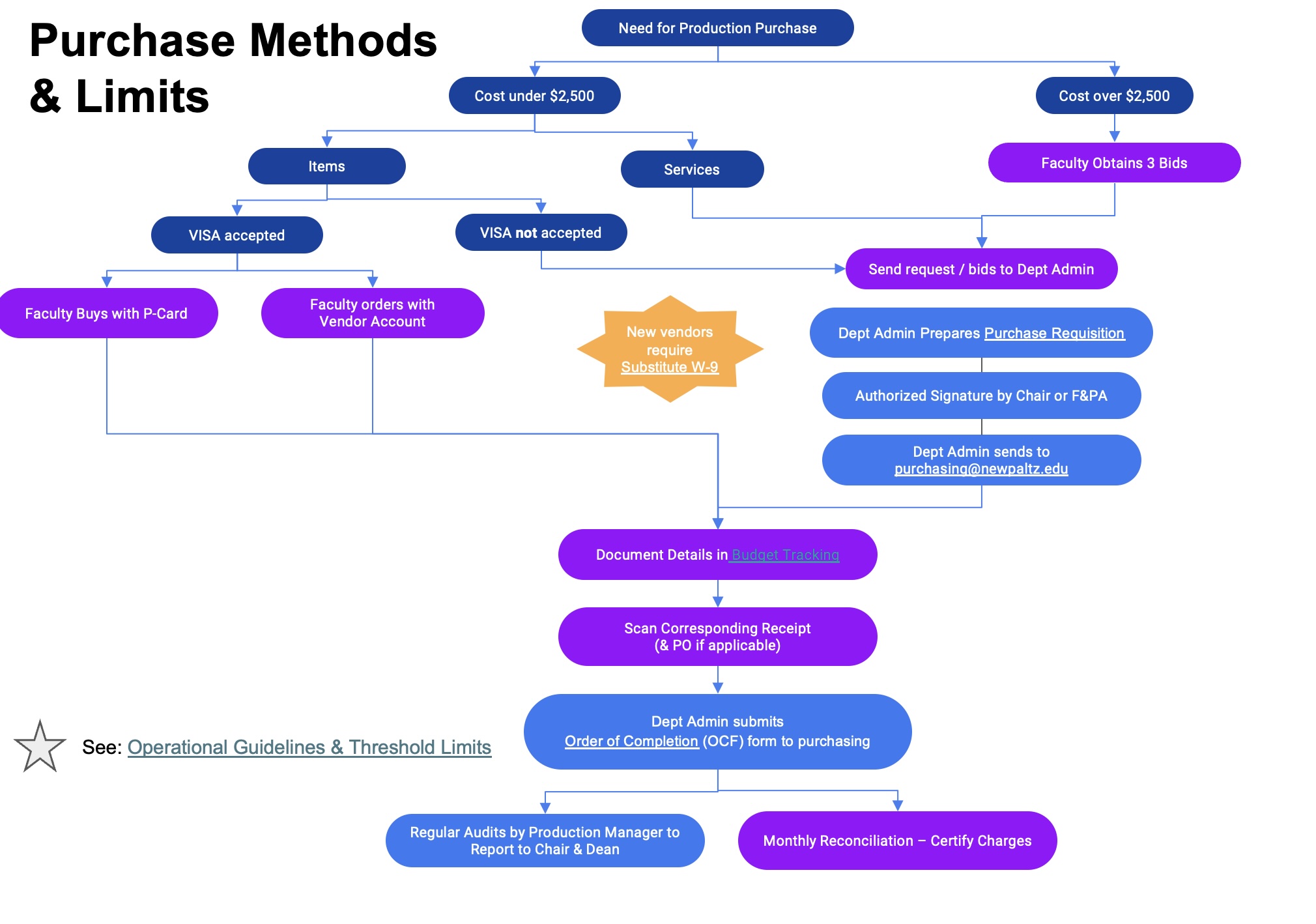
Small-dollar commodity purchases between $0.01 and $2,499.99 may be placed on a faculty’s university-issued P-Card.
- NOT meant to pay for services.
Vendor Accounts (Amazon)
To request Amazon purchase, email description & link of item to an authorized faculty buyer:
- Travis McHale
- Diane Feller
- Joel Sherry
- Kaitlyn Kociela Taylor
Note: Amazon purchases are discouraged when item can be ethically sourced elsewhere.
See: Purchasing Links
- Perishable purchases may be made for productions with justification. Recommended use of Shoprite vendor account: card picked up in purchasing office.
Purchase Requisitions
Used for all purchases of $2,500 or more. Also used for payment (of any amount) for services or if a vendor does not accept VISA.
A completed Purchase requisition form must be created by Dept Admin and submitted to Purchasing.
Purchasing will issue a Purchase Order to the vendor on your behalf.
- Purchases of $2,500 or more require documentation of 3 competitive quotes. For specialized items without bid options, a sole vendor justification is required.
General Guidelines for all Purchasing
As a state institution, there are guidelines on what may be purchased.
Please see: Expenditure Guidelines Matrix
- A Tax exempt form must be used for all eligible items.
- Alcohol and tobacco cannot be purchased with departmental funds and will not be reimbursed.
- Using personal money is discouraged and must be discussed with the Production Manager prior to the purchase. Ignoring this practice may result in you becoming liable for the full price of the purchase.
- You may not sign contracts or purchase requisitions/orders.
Record Keeping
Complete purchasing records must be kept in a shared folder with Production Manager for auditing purposes.
- A line item entry of the purchase on budget tracking sheet; and
- A detailed receipt confirming payment for each P-Card purchase; or
- A copy of the Purchase Requisition and quote/invoice
Week Nights
Rehearsals may not last longer than FOUR hours per day Tuedsay through Friday during regular rehearsals with a maximum of SIX hours during Tech Week. The latest that any cast or crew person may be held even during tech and dress rehearsals including production meetings is 10:30 PM except for the 8/10 which may go till 11 p.m. For shows that have particularly dense technical needs, and shows that are quite long as written, the Chair may extend this to 11 p.m. This determination will be done 48 hours before the first tech rehearsal.
No general call is allowed before 6 p.m. during Tech Week. (See Rehearsal Calls below.) It is understood that the Management team may need to be called 30 minutes prior to a standard call.
Non-Tech Weekends
A maximum of SIX hours daily will be permitted to rehearse on Saturday OR Sunday. Students are to be given one complete weekend day and one weekend evening after 6 p.m. free from rehearsals of any kind. No more than SIX consecutive hours will be permitted without at least a one-hour break. It is understood that the Management team may need to be called 30 minutes prior to a standard call. But this time should be kept to a minimum.
Rehearsal Period
The rehearsal period allowable for major productions is normally four weeks plus the week of tech and dress rehearsals with the musical having five weeks plus tech. Exceptions must have the approval of the Producer.
Recesses
Rehearsal and other production activity must be avoided during official, extended (three days or more) University recesses unless previously approved by the Producer before the rehearsal process has begun.
These rehearsals must be made known at the auditions. Requests for exceptions to this policy must be submitted in writing to the Producer if not already present on the Production Calendar.
Classes Cancelled, Rehearsal/Performances Cancelled
If, for any reason, classes are cancelled during the course of the day, then rehearsals and performances are cancelled. The Producer has the discretion and the responsibility to cancel a rehearsal or performance due to circumstances that may not apply to the entire campus. For example, a snowstorm on a Sunday may not require the campus to close but may lead to unsafe conditions for a rehearsal or performance.
Rehearsal Schedules
At the beginning of each week the rehearsal schedules should be posted. This includes all daily calls, technical and dress rehearsals, brush-up rehearsals, photo calls and strike calls. Deviations from the schedule should be announced 48 hours in advance for faculty and students to have time to adjust their schedules. Schedules will be created and distributed by the Stage Manager and posted on the Call Board to be seen by all members of production. Additional private coaching sessions are allowed up to a limit of 1.5 hours/week/student.
Space Maintenance
It is the responsibility of each Stage Manager to ensure that the rehearsal space is left clean and neat at the end of each rehearsal. That said, each company member should be respectful of the space as there is an enormous amount of use of our rehearsal spaces and all spaces must be kept clean.
Each production crew is required to clean up before the end of a work call. This includes the following:
- Clearing, sweeping and mopping the stage
- Storing of all costume and prop pieces in between rehearsals and performances
- Returning the space to how it was found before rehearsal/the run
Tech
Also known as "Production weekend," "tech week," "dress rehearsals," "technical rehearsals," etc., cast and crew members must understand that these rehearsals are mandatory.
No more than five consecutive hours will be permitted without at least a one-hour break, except during Tuesday to Friday of Tech week, when six hours is the maximum length of a rehearsal and no meal break is required beyond the mandatory five- and 10-minute breaks.
The nature of these rehearsals varies from show to show and the Stage Manager will announce this schedule at an early date, making clear who is or is not called for any given rehearsal. No company member can miss any of these rehearsals without the permission of the Production Manager or Producer. Rehearsals may not run past 10:30 p.m. unless determined in advance and granted by the Chair. There must be a minimum of 12 hours turn-around between the end of one rehearsal and the beginning of the next—this is particularly important in the standard calendar between Friday end of day and Saturday calls. There MUST be a Sunday off between the beginning of Tech and Opening.
Rehearsal Breaks
For all rehearsals, a five-minute break must be taken for every 55 consecutive minutes of rehearsal, or for every 80 minutes (one hour and 20 minutes) of consecutive rehearsal, a 10-minute break must be taken. This is based on Equity guidelines for rehearsal breaks. All breaks will be administered through the Management team and are notated on the Rehearsal Report
Work Call Breaks
For every two hours of labor, there must be a 10-minute break. A one-hour meal break must be provided for any work call exceeding six hours and a no work call can exceed a span of nine hours with the exception of the 8/10. Breaks should be given out by whoever organized the work call.
Orchestra Rehearsals
The Music Director/Conductor organizes all orchestra rehearsals for musical productions. Depending on the complexity and scope of the musical score, rehearsals are broken into units by Act. Generally, the orchestra rehearses each act separately. Cast members are not required at orchestra rehearsals though often the Music Director may request a limited number of voices for “reference” vocals which aid in the rehearsal.
The first-time cast members and the orchestra are integrated during the sitzprobe (see sitzprobe). After that, the orchestra is loaded in during the Saturday of tech week and thereafter attends each rehearsal and performance.
It is also possible that, depending on the stage position of the orchestra, they may be asked to attend other rehearsals. The number of rehearsals orchestra members attend must be fixed in advance of the rehearsal period, as the number of “services” is used to determine the contract compensation for musicians.
The Stage Manager is responsible for organizing the logistics and physical space configuration for orchestra rehearsals.
Lateness
Cast or crew members are required to inform the Stage Manager of any expected lateness at the time of audition. Lateness will only be excused if a student is tardy because of scheduled class time, emergencies, or illness. Any other lateness will be accounted for. Three latenesses will be grounds for dismissal from the cast. On the third lateness, the student will be dismissed from the cast. See “Rehearsal Absences” for details about dismissal. Once dismissed, students will be ineligible for casting in the next semester.
Rehearsal Absences
Cast members are required to attend all rehearsals for which they are called unless Directors are informed of prior commitment at the time of audition. Permission to miss any rehearsal call must be obtained from the Director, and if tech, the Producer. In the case of illness, the student must personally contact the Stage Manager at least one hour before the call. Unexcused absences will be grounds for dismissal from the cast. Once dismissed, students will be ineligible for casting the following semester.
Performance Calls
Actor performance calls are 60 minutes before curtain. Extra time needed for hair, makeup, costume or other preparation is the responsibility of the Actor in coordination with the Wardrobe Supervisor. Crew performance calls are 90 minutes before curtain. The Stage Manager may set the time earlier only for specific technical considerations. In all cases, every effort shall be made to keep the call time to a minimum. All cast and crew must sign in at their assigned call time. Any additional pre- or post-performance calls must be announced no later than opening night.
Electronic Devices and Social Media
The use of electronics by the company is prohibited unless it is pertinent to the job or has been cleared by your supervisor.
Taking of photographs or video in the rehearsal hall, backstage spaces and dressing rooms for personal use or posting on social media is prohibited unless cleared in advance or are part of the organized social media campaign of the department. Information posted online should not violate Department of Theatre or University policies.
As outlined by the licensing agreement, video capture of the rehearsals may be permissible when used by the creative team to communicate and coordinate the needs of the production. Such videos should never be shared publicly on social media.
Photos will be captured for each production and made available for use in portfolio/websites of individuals connected to the production.
Call Boards
The call board is a backstage bulletin board for cast, crew, and staff and is to be maintained by the Stage Manager. The call board contains relevant information in regards to the production process for performers and other members of the team.
This includes the following:
- Emergency phone numbers
- Daily calls
- Rehearsal schedules and calendars
- Sign-in sheet
- Sign-up sheets for fittings
- Company rules
- First Aid information
- Location of fire extinguishers
- Cast list
- Firearms safety
DEPARTMENT OF THEATRE ARTS COMPANY PROTOCOLS
Each Company Member will be expected to adhere to the following, and cast members will sign and return a copy of this document within the first week of rehearsal. Some productions will require additional guidance added to this list.
Please note that failure to adhere to these protocols could result in removal from the project or the cancellation of the project entirely.
All campus policies apply to Rehearsals and Productions. Here are additional protocols and policies for departmental rehearsal:
- Follow all guidelines outlined in the Production Handbook.
- If you are ill, do not attend rehearsals. Please notify Stage Management asap.
- Follow heightened measures of personal hygiene including but not limited to washing and/or sanitizing your hands before rehearsal and before returning from a break.
- In accordance with the SUNY New Paltz Student Handbook please read carefully the campus policy regarding drug use. If a student attends a rehearsal or performance under the influence of drugs or alcohol, they will be removed from the project immediately.
- You must follow the Fall 2025 COVID guidelines. Please stay up to date on that policy.
- Please do your part to keep areas clean and sanitized.
- Check in at the start of each rehearsal with your Stage Manager or area supervisor.
- Arrive to your calls with enough time to begin your work at the start time. If you are running late, please take the time to alert the Stage Manager via phone or text first. (Do not text while driving.)
- Conflicts not previously listed on the audition form, or at the time of accepting the position are not accepted unless in the case of an emergency.
- Please report any injury, large or small to the Stage Manager immediately.
- Cell phones and other electronic devices should not be seen or heard during rehearsal or performances. Read the Production Handbook for guidance regarding Social Media.
- Please dress in a professional and appropriate manner for the work being asked of you. Shirts, pants/shorts, and closed-toe shoes are required unless otherwise specified and provided by the Costume Department. Clothing identified by the faculty as displaying offensive language or graphics is NOT permitted.
- Please notify the Stage Manager if at any time you leave the theatre.
- In rehearsal when not working, keep noise to a minimum.
- Stay quiet backstage to hear directions and as a courtesy to others.
- Please do not touch anything that is not yours (props, costumes, etc.) without permission in advance, if you find something is broken, please let SM know asap.
- No visitors are allowed in the house, onstage or backstage during rehearsals/performances without prior permission from the Producer, Director and/or Stage Manager.
- No food or drink permitted on stage or backstage except water or clear tea. Do not leave trash laying around for others to clean up, and put everything back where you found it.
- Please refer to the Production Handbook with regard to lateness and absences from rehearsals – repeated lateness/absences could result in removal from the production. This includes coaching sessions and costume fittings.
- DECORUM. RESPECT. PROFESSIONALISM. SAFETY. These are qualities required at all times. Inappropriate attitude towards your peers, faculty, staff or those who are peer authorities could result in removal from the production.
- Any questions or concerns may be brought up to your Stage Manager, Company Deputy, Director or the Producer.
Please download, sign and return the Theatre Arts Company Protocols to acknowledge that you have read and understand these terms.
Student Explorations in Theatre Bylaws
In this document:
The term “SET Producer” refers to the student submitting the project for consideration in the SET season.
Student Explorations in Theatre, formerly Praxis, may be abbreviated to SET. Student organization New Paltz Players may be abbreviated to NPP.
Student organization Tech and Design Association may be abbreviated to TADA.
Click on the title of any section to expand and collapse information.
Section 1: Rules for the SET Producer +
1a. The SET Producer may not:
- Have any control over the creative team of their proposed project other than the director - see Section 8.
- Offer roles to actors ahead of auditions.
- Submit proposals after the due date.
- Have a seat on the SET committee or any say in SET selection in the academic year that their proposals are submitted for.
- Determine rehearsal and performance calendar. All SET productions will adhere to rehearsal and show schedules provided by SUNY New Paltz’s Theatre Arts Department.
1b. The SET Producer should:
- Note clearly and effectively in the proposal if their projects require: weapons, fight choreography, intimacy, or anything else not part of a basic SUNY New Paltz production.
- Estimate budget needs within their project based on overall project budget information supplied by the SET committee
-
Licensing Rights, special materials, etc.
-
1c. SET Producer requirements:
- SET Producers who are not intending to direct their projects will include a director in the proposal.
- In order to qualify for the position of director on a SET project, one must have completed at least one show as Assistant Director and/or successfully completed (or be currently enrolled in) THE441 (Directing 1) prior to the production of their project.
- If proposing a musical, the SET Producer must include a music director in the proposal.
Section 2: SET Committee +
2a. Set Committee Breakdown:
- Production Manager
- Evaluates overall plausibility of proposals through management of the SET committee and SET season.
- Coordinates logistics for all areas of SET production.
- Technical Director/Tech & Design Representative
- Communicates with technical faculty pre-production.
- Evaluates technical plausibility of proposals.
- Represents the interest of the Tech & Design concentration students.
- Treasurer
- Tracks departmental SET budget allocation.
- Prepares a production budget for each show selected.
- Maintains current, itemized record of all related expenditures.
- Performance Representative
- Represents the interest of the Performance concentration students.
- May, but is not required to, hold the same position on the NPP e-board.
- Theatre Studies Representative
- Represents the interest of the Theatre Studies concentration students.
- May, but is not required to, hold the same position on the NPP e-board.
- NPP President
- Represents the interest of NPP as a whole.
- If proposing a SET project or applying for a different role on the committee, the NPP Vice President or other e-board members will assume the role of the NPP President on this committee.
- TADA President
- Represents the interest of TADA as a whole.
- If proposing a SET project or applying for a different role on the committee, TADA Vice President or other e-board members will assume the role of the TADA President on this committee.
2b. Role of the SET Committee:
The SET Committee is responsible for collecting submissions and voting on SET proposals to determine which submissions will be accepted and produced in a SET season.
2c. Rules for the SET Committee:
- At minimum, two members of the committee will read each proposed script.
- Each member of the SET committee must commit to being as unbiased as possible in the consideration and selection of SET projects.
2d. Forming the SET Committee:
- Vote open to the entire Theatre Arts Department student body.
- NPP & TADA Presidents as well as Theatre Arts faculty members have the right to reject an application for the committee.
2e. Notes on the SET Committee:
- The SET committee should be comprised of students from a diverse selection of disciplines
- Actors, various technical disciplines, management, directors, dramaturgs, etc.
- The SET committee can include people from NPP’s and TADA’s e-boards, as well as other students.
- No one on the SET committee is permitted to submit a SET proposal.
- If someone applies to be on the SET committee and submits a SET proposal, the first form submitted will be acknowledged and the second will be rejected.
Section 3: Proposals +
3a. Proposal format
- Proposals will be submitted via Google Form sent out to all Theatre Arts majors and minors prior to each season.
- The entire SET committee will have access to these responses.
- The form includes the following:
- Tier 1: Full Production
- Tier 2: Workshop
- Tier 3: Staged Reading
- The full name of the SET Producer
- The New Paltz (.edu) email of the SET Producer
- The name of the proposed play/project with author and licensing house
- The tier(s) that are acceptable to the SET Producer - see Section 6.
- Submission of a copy of the project (script/score).
- Submission of a proposed budget for the project including licensing/royalties/printing, production elements, etc.
- Preferred semester for production and why (i.e. you're graduating in the fall, or you're hoping for/have a production assignment in the spring).
- Written statement describing the ways in which the project serves the community and department
- The faculty advisor for the project
- A signed copy of this document confirming that the SET Producer has read it in full and agrees to all of its terms.
- Proposals must be submitted by the end of the Spring semester preceding the preferred SET season (academic year).
Section 4: Finances +
- The SET Producer MAY NOT use their own money (No exceptions.)
- Purchases will be made on a department P-card.
- It is the responsibility of the SET Producer or the treasurer to ask someone with a P-card (faculty, administrative assistant, etc.) to make the purchase for them.
- Purchase requests must be made a minimum of one week before the purchase needs to be made.
- The cardholder must be informed that the purchase should be from the TADA/NPP SET budget. The Department Chair can provide information for the specific budget account.
- There will be a total budget of $2000 – including $1000 allocated to each club – for SET each year.
- It is the responsibility of the SET Producer to allocate funds to various areas of their production while building the budget and to manage those allocations, providing that information to the SET Treasurer.
- SET Treasurer will create the final budget for each production based on the proposed budget submitted in the SET proposal.
Section 5: Rehearsal +
- 5a. Rehearsal Location
- All rehearsals for SET projects will be in the Movement Studio (SAB116) until the last mainstage show is out of Parker.
- 5b. Rehearsal Schedule
- Tier 1: 1 month
- Tier 2: 3 weeks (1 month if musical)
- Tier 3: 1 week (2 weeks if musical)
- Different tiers of SET projects will be given different amounts of rehearsal time.
Section 6: Technical Rules and Allotments +
Please note: All technical faculty have final approval of all work done by their students. Extra labor by all crews (TAP, Work Study, Student Assistant) is not guaranteed for SET projects.
- Tier 1: Full Production
-
6aa. Lighting and Sound
- Lighting and Sound must be designed from the repertory systems with modifications that can be completed in a reasonable timeframe as determined by the rehearsal schedule, crew heads, and allotments
- Sound
- No wireless mics
- May not use copyrighted music if charging admission
- Access to 5 wired comms and 4 wireless comms, 2 channels (A/B) with Partyline function.
- Lighting
- Can change color on conventional fixtures.
- Can hang up to 4 new specials and refocus existing specials.
- Moving Lights and LEDs will need to be discussed with faculty for approval.
- No spots.
- No haze.
- Sound
- 6ab. Scenery and Props
- Scenery
- Only stock scenery and scenery from previous shows from the current semester may be used.
- Designs must be submitted before rehearsals begin.
- Crew heads will determine if the scenery can be constructed within a reasonable timeframe, and will offer suggestions for modifications if necessary. The design must be less elaborate than that of a typical mainstage show.
- Props
- SET productions may not use props which are allocated for use by mainstage productions.
- SET Productions should first source prop needs from stock.
- Prop needs which cannot be met with stock props must be communicated during pre-production to faculty, crew heads, and the SET Producer.
- No glassware.
- Use of weapons and smoking/drinking paraphernalia must be discussed with faculty for approval.
- Extra labor (i.e. for building props) is not guaranteed.
- Strike plans require putting props completely This plan must be communicated to scenic faculty.
- SET Productions must follow the rules and standard practice outlined on the prop process sheet.
- Costumes
- Stitching help from the costume shop staff is not guaranteed.
- Dry cleaning must be included in SET budgets.
- Costume designer/stylist is responsible for overseeing strike (including but not limited to: laundry/dry cleaning, clearing and cleaning dressing rooms, sanitizing, restocking all items).
- Designer/Stylist must register for TAP/R&P depending on show scale and other production commitments.
- Wardrobe crew of 1-2 is possible, but not guaranteed.
- Scenery
- Lighting and Sound must be designed from the repertory systems with modifications that can be completed in a reasonable timeframe as determined by the rehearsal schedule, crew heads, and allotments
-
- Tier 2: Workshop
- 6ba. Lighting and Sound
- Lighting and Sound must be designed from the repertory systems with slight modifications that can be completed in a reasonable timeframe as determined by the rehearsal schedule, crew heads, and allotments listed.
- Sound
- No wireless mics
- May not use copyrighted music if charging admission.
- Access to 5 wired comms and 4 wireless comms, 2 channels (A/B0 with Partyline function.
- Lighting
- Can change color on conventional fixtures.
- Can refocus existing specials.
- Moving Lights and LEDs are not guaranteed and will need to be discussed with faculty for approval.
- No spots.
- No haze.
- 6bb. Scenery and props
- Scenery
- Scenery should be derived of mostly completed elements pulled from stock with only minor additions and very minimal painting required.
- No furniture that requires more than 2 people to lift may be used.
- Props
- SET productions may not use props which are allocated for use by mainstage productions.
- SET productions should first source all prop needs from stock.
- Prop needs which cannot be met with stock props must be communicated in preliminary lists to faculty, crew heads, and the SET producer.
- No glassware.
- Use of weapons and smoking/drinking paraphernalia must be discussed with faculty for approval.
- Extra labor (i.e. for building props) is not guaranteed.
- Strike plans require putting props completely away. This plan needs to be communicated to scenic faculty.
- SET Productions must follow the rules and standard practice outlined on the prop process sheet.
- Scenery
- 6bc. Costumes
- SET Productions at this tier will have a costume stylist and not a costume designer.
- Stitching assistance will not be provided by costume shop staff.
- Stylists should communicate with actors so that the actors can provide as much of their own costume as possible.
- Any pieces which actors cannot provide must be pulled from stock.
- No more than one load of laundry will be permitted per performance.
- Wigs are not permitted.
- Makeup should not be more elaborate than basic stage makeup.
- Stylist is responsible for overseeing strike (including but not limited to: laundry/dry cleaning, clearing and cleaning dressing rooms, sanitizing, restocking all items).
- There will be no wardrobe crew. All wardrobe duties are the responsibility of the stylist.
- 6ba. Lighting and Sound
- 6c. Tier 3: Staged Reading
- 6ca. Lighting and Sound
- Sound
- No wireless mics.
- May not use copyrighted music if charging admission.
- Access to 5 wired comms and 4 wireless comms, 2 channels (A/B) with Partyline function.
- Lighting
- Can change color on conventional fixtures.
- Moving Lights and LEDs are not guaranteed and will need to be discussed with faculty for approval.
- No spots.
- No haze.
- Sound
- 6cb. Scenery and Props
- SET productions at this tier may use only items found in our inventory.
- SET productions may not use props which are allocated for use by mainstage productions.
- No weapons. No glassware.
- Smoking/drinking paraphernalia will need to be discussed with faculty for approval.
- SET Productions must follow the rules and standard practice outlined on the prop process sheet.
- 6cc. Costumes
- SET Productions at this tier will have a costume stylist and not a costume designer.
- Actors provide base layers. Necessary wearable accessories may be pulled from stock, under consultation with stylist.
- Limit 2 stock items per actor.
- No laundry will be cleaned by the costume shop.
- No wigs. Basic stage makeup only.
- Stylist is responsible for overseeing strike (including but not limited to: laundry/dry cleaning, clearing and cleaning dressing rooms, sanitizing, restocking all items).
- There will be no wardrobe crew. All wardrobe duties are the responsibility of the stylist.
- 6ca. Lighting and Sound
Section 7: Directorial and Performance Rules and Allotments +
- 7a. Tier 1: Full Production
- 7aa. Staging
- A full production includes actors who are off-book and the production must be fully staged
- A full production CANNOT be a musical
- 7ab. Length
- Can be 2 acts, with an intermission.
- Cannot be longer than 2 hours.
- 7ac. Cast Size
- Cast of 12 or fewer actors.
- 7aa. Staging
- 7b. Tier 2: Workshop
- 7ba. Staging
- Workshops will be presented with scripts in hand or on stands. Therefore, blocking must be limited and the actor must have access to their own script during the show.
- 7bb. Length
- Can be 2 acts, with an intermission.
- Cannot be longer than 2 hours.
- 7bc. Cast Size
- Cast of 10 or fewer actors.
- 7ba. Staging
- 7c. Tier 3: Staged Reading
- 7ca. Staging
- There should be little-to-no staging, scripts will be on music stands.
- 7cb. Length
- One act.
- Cannot be longer than 90 minutes.
- 7cc. Cast
- Cast of 6 or fewer actors.
- 7ca. Staging
Section 8: Creative Team Allotments +
Directors, Production Stage Managers, and Designers may get R&P or TAP credit for SET productions with faculty approval.
Other production assignments may get TAP credit with faculty approval.
- 8a. Tier 1: Full Production
- Director, Asst. Director
- Stage Manager, ASM(s), and PA (if needed)
- Lighting Designer, Programmer, Head Electrician, Board Operator
- Sound Designer, Assistant Designer (if needed), Board Operator
- Costume Designer, Wardrobe team of 1-2 (if needed, not guaranteed)
- 8b. Tier 2: Workshop
- Director, Asst. Directory (if needed), Music Director (if applicable), Asst. Music Director (if applicable)
- Stage Manager, ASM, and PA (if needed)
- Lighting Designer, Programmer, Head Electrician, Board Operator
- Sound Designer, Assistant Designer (if needed), Board Operator
- Costume Stylist
- 8c. Tier 3: Staged Reading
- Director, Music Director (if applicable)
- Stage Manager, ASM (if needed)
- Lighting Designer, Programmer, Head Electrician (if needed), Board Operator
- Sound Designer, Board Operator
- Costume Stylist
Section 9: Musicals +
- In the case of a SET Musical in a semester with no Mainstage musicals, musical auditions can be submitted digitally (via self-tape).
- SET productions cannot have a choreographer.
- SET producers proposing musicals must attach a Music Director to the proposal.
- In the case of a live band, SET producers must attach musicians to the proposal.
- Musicals can only be in Tiers 2 or 3.
- SET musicals can only be in the Fall semester.
Section 10: Marketing +
- As part of the Theatre Arts Department, SET marketing must go through the Unviersity's Office of Communication and Marketing.
- SET shows may be on the Theatre Arts Department banners and other marketing material with the mainstage productions only if all decisions are finalized by the time the department's marketing materials are being designed (generally during the summer).
- Communication on SET marketing will be initiated by the producers and SET committee in accordance with the timeline provided by the Theatre Arts Department and the Office of Communication and Marketing. It is the students' responsibility to acquire information on this timeline and prepare and/or provide the necessary materials and information to the Theatre Arts Department and the Office of Communication and Marketing
- Ticketing
- Ticketing needs must be communicated to the box office manager.
- Price of the ticketing platform must be accounted for in the budget.
- Tickets can require payment or be provided free of charge. Free tickets should be provided on Opening Night for theatre students (similar to Mainstage gala pricing, though there will be no gala for SET Productions).
Section 11: Auditions +
- Will be held with the Mainstage auditions.
- In the case of a SET musical in a semester with no Mainstage musicals, musical auditions can be submitted digitally.
- Mainstage productions have the priority for casting decisions.
- SET Directors will be able to observe Mainstage auditions but cannot use their own audition materials.
- SET callbacks will be held the weekend after Mainstage callbacks.
- If directing a SET production, you may not audition for any productions in the same semester.
- If you are not directing your SET production, you may audition, even if you are serving in any other role on your production (such as stage manager, music director, designer).
Department of Theatre Arts
Complimentary Ticket and Seat Hold Policy 2025-2026
Industry / VIP
- 4 total house seats are held for each performance:
- 2 seats are released one week before, if not claimed.
- 2 seats are released a half hour before start, if not claimed.
Directors & Designers
- 2 seats total (in back of house) held for each performance for production-related duties. Must be claimed by half hour, or holds are released.
- 2 seats per Director/Designer are reserved for the Gala Opening. If not claimed 2 weeks before, holds are released.
- Each Director/Designer is entitled to 2 additional complementary tickets for the run of performance, subject to seating availability. If not claimed 2 weeks before, holds are released.
- Invitations to the Gala Opening and to special guests are sent by the Department Chair.
Theatre Student & Faculty/Staff
- Entitled to 1 complementary ticket for the Gala Opening or any one performance during the run of the show.
Tickets must be picked up physically in Parker Lobby Box Office with ID.
General Student (with ID)
- Discounted rate at $5 per performance
General Faculty/Staff & General Audience
- $10 performance / $20 musical performance
Click here for the Comp Ticket Request Form.
Claiming holds emailed to thompsor@newpaltz.edu.
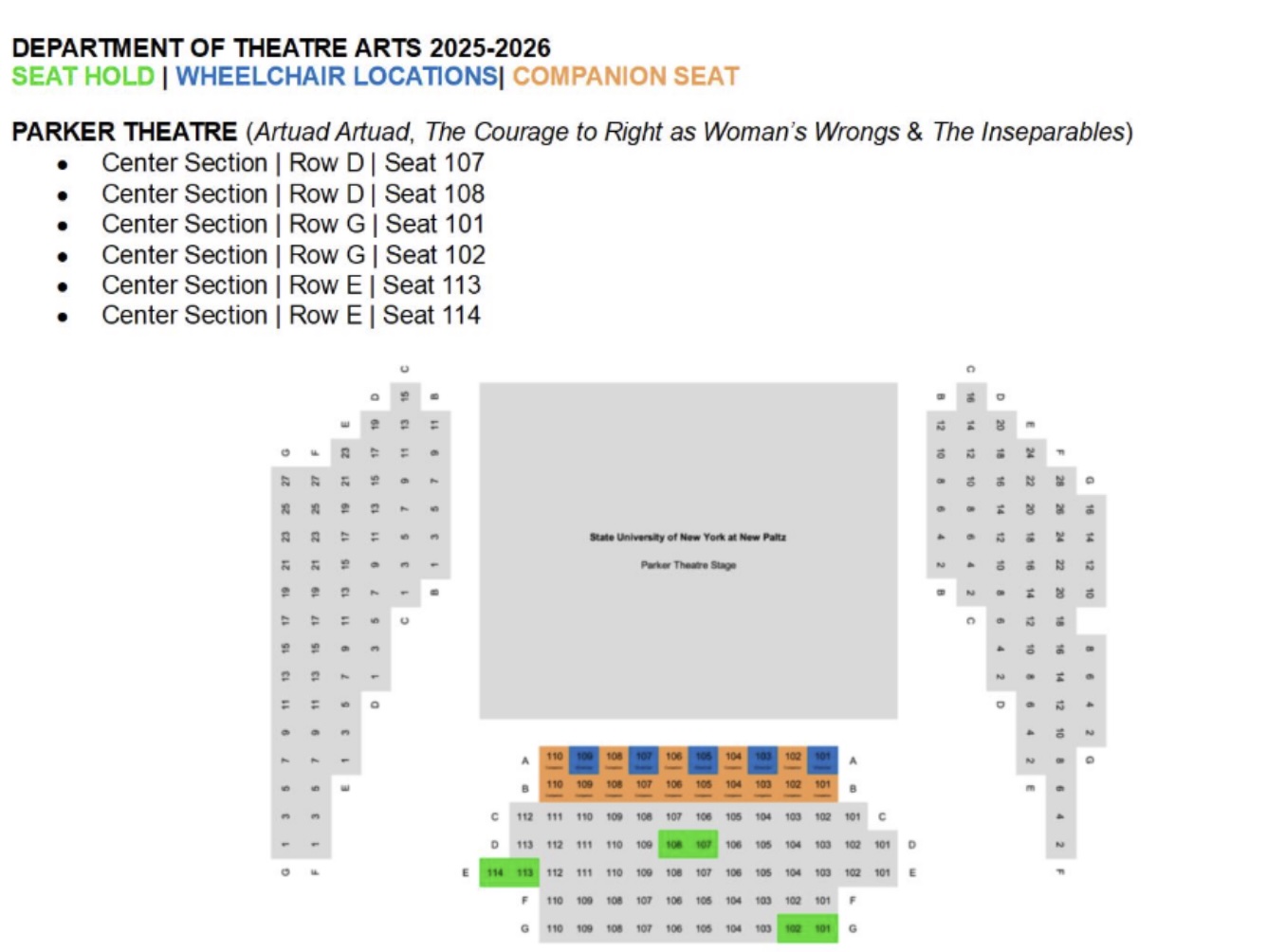
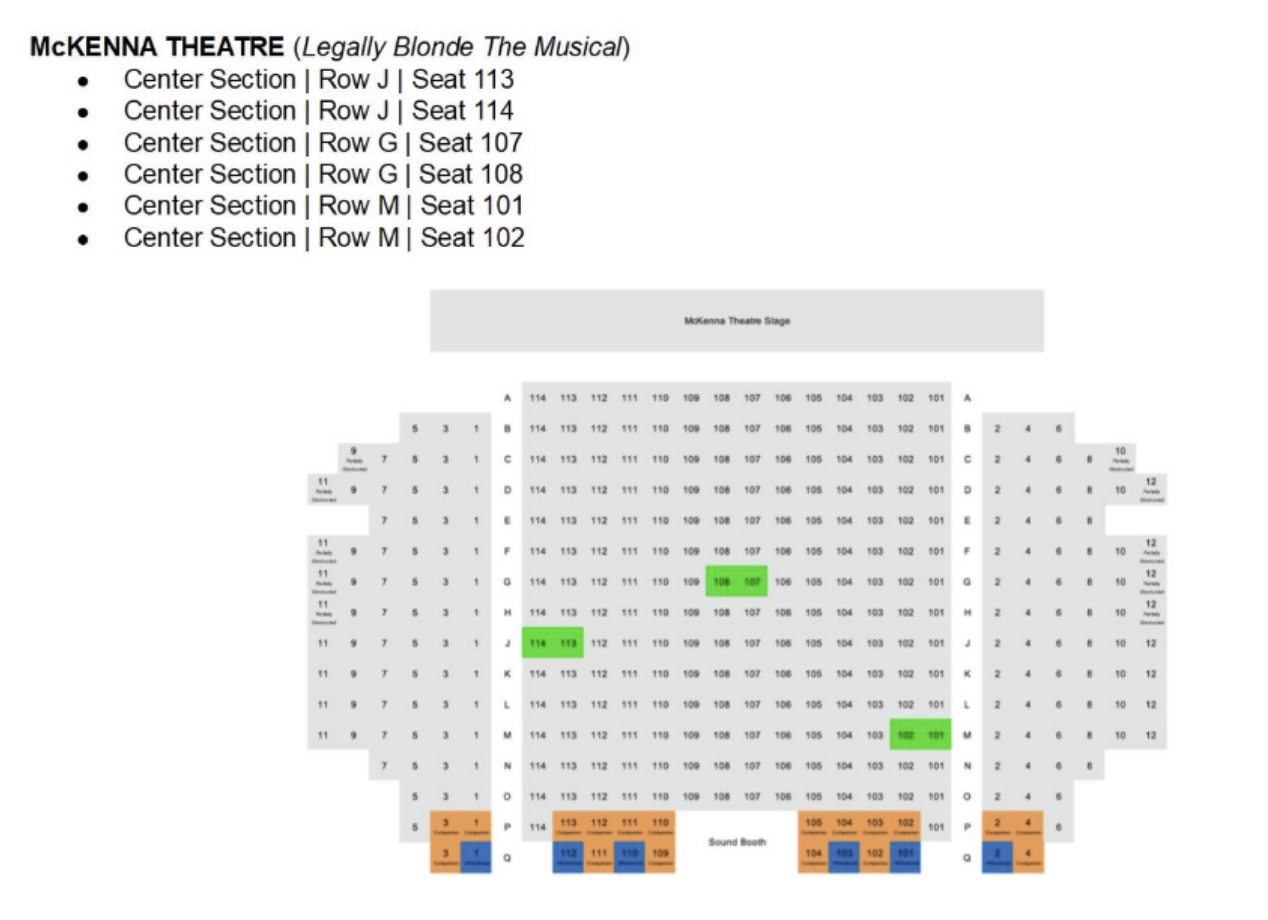
COMPANY DEPUTY
JOB DESCRIPTION AND RESPONSIBILITIES
The Company Deputy of a production acts as a liaison between the production company (cast and crew) and the departmental faculty to ensure adherence to the rules and regulations of the Departmental Production Handbook and expected on and off-stage professional decorum. The Company Deputy is a member of the acting company in either the Mainstage or Praxis productions. The Deputy will facilitate communication regarding grievances, concerns or issues raised by one or more of the company members. The Company Deputy acts as a reporting agent only. The Company Deputy does NOT arbitrate nor attempt to solve grievances.
The Company Deputy will be selected by the Theatre Arts Faculty within one week of casting.
The Company Deputy, in the event of a grievance, concern or issue, will bring the issue
- First to the attention of the Stage Manager if it is a “management” grievance such as timeliness of schedule distribution, costume fittings, maintaining the breaks, rehearsal hours, etc.
- If not resolved with the Stage Manager, the Deputy will take the grievance to the Production Manager(s) of the department.
- If the Production Manager(s) are not available in a timely fashion, the Deputy should report to the Producing Chair of the Department or The Chair of the Department.
The Company Deputy should be familiar with the rules and regulations set forth by the Theatre Arts Department Production Handbook and it is recommended the Deputy have a copy of the handbook on hand at each rehearsal and performance.
The grievance process is as follows:
- The company member(s) raises the issue with the Deputy outside of the rehearsal/production hours (i.e. this conversation should not take place in public).
- The Deputy reports the issue to the Stage Manager, PM(s) or the Associate Chair/Chair as stated above.
- The Deputy reports the issue on behalf of the company member(s) anonymously UNLESS requested otherwise by the company member(s).*
- The Deputy will report back to the company member(s) that the grievance has been expressed to management.
THE COMPANY DEPUTY IN NO WAY AFFECTS OR INFLUENCES R&P OR TAP GRADING. GRADING IS THE SOLE RESPONSIBILITY OF THE FACULTY SUPERVISOR/ADVISOR.
Please note: Any interpersonal grievances or issues unrelated to the production should not be brought to the Company Deputy to navigate.
*The Department of Theatre Arts Faculty reserves the right to request identities of individuals if the grievance or violation warrant a larger conversation; for example: harassment or bullying.
Please see the University's Non-Discrimination and Non-Harassment policy.
Content coming soon.
Casting +
The Department is committed to inclusive casting. Productions will be cast in a manner consistent with the principles outlined by the British Equity Inclusive Casting Policy included below:
Inclusive Casting Policy Statement
Women, black, Asian and minority ethnic, lesbian, gay, bisexual and transgender (LGBT), and deaf and disabled artists have long experienced and continue to experience discrimination across the industry.
An increasingly diverse audience both wants and expects to see and hear itself reflected authentically in the media and its expectations are even higher of publicly funded theatres and broadcasters. Moreover, productions that go beyond a tick-box approach to diversity have demonstrated wide appeal to all audiences and delivered real commercial success.
Equity believes that inclusive casting is crucial to achieve both a balanced portrayal of women, black, Asian and minority ethnic, LGBT and Deaf and disabled people across the industry - providing both a level playing field for our members - and a realistic and authentic mirror reflection of UK audiences.
Equity calls for greater incidental portrayal – where the artist’s personal characteristics are incidental to the role – providing real opportunities to increase diversity on stage and screen
- Equity believes that artists from diverse backgrounds (on the basis of gender, ethnicity, disability and sexual orientation) should be considered more seriously for any role - and not confined solely to those written with their own personal characteristics in mind.
- Equity is concerned that casting of people from diverse backgrounds on screen and on stage continues to be tokenistic and calls for greater representation in leading roles.
- Equity believes that productions should ensure they audition a diverse list of artists for every role.
- Equity asks productions to make proper use of the occupational requirement provisions in the Equality Act 20101 - and to consider using the ‘tie-breaker’ provisions in the Equality Act 20102 - when casting any role.
Equity calls for greater care and consideration by productions when casting roles where the artist’s personal characteristics are relevant to the role:
- Make proper use of the occupational requirement provisions in the Equality Act 20103 when casting roles written for a character with a diverse background – ensuring that more artists reflect the character’s characteristics where it is relevant.
- Equity recognises that non-disabled artists playing disabled characters, is widely considered to be offensive to disabled people. Equity understands that on occasion, it may not be possible to cast a disabled artist but calls on productions to follow these principles in every instance:
- Considering every avenue to cast a disabled Actor.
- Considering whether a disabled character’s impairment has to be specified – or whether the role can be played with an Actor with a different impairment.
- Considering using special effects, make-up or other artifice if there are elements of the portrayal which require non-disability (which a non-disabled Actor would employ to play a disabled character)
- Actively seek an artist whose characteristics reflect that of the role by:
- If that is not possible, be prepared to demonstrate the extent of the search undertaken and;
- Consult with people with the relevant impairment to enhance the portrayal overall.
1 Schedule 9, Part 1, Para. 1, Equality Act 2010) setting out the employer’s legal entitlement to require an artist to have a particular protected characteristic if it is an occupational requirement and a proportionate means of achieving a legitimate aim. The legal explanatory notes make reference to: “The need for authenticity and realism might require someone of a particular race, sex or age for acting roles”
2 Section 159, Equality Act 2010 – permitting under representation of a protected characteristic to be taken into account when deciding who to recruit where candidates are as qualified as each other
3 Schedule 9, Part 1, Para. 1, Equality Act 2010) (as above)
Equity calls for all productions to play their part in improving equality practice across the industry:
- Equity believes that all parts of the industry should develop clear, specific and measurable objectives to promote diversity among casts, audiences and staff.
- Equity calls for equality monitoring of performers, stage management and creative teams and for that data to be made publicly available.
- Equity calls for the industry to set targets for casting artists from diverse backgrounds.
- Equity reminds productions of their obligations under the Equality Act 2010 – and the legal risk they expose themselves to by:
- Asking artists about their personal characteristics during auditions
- Failing to make reasonable adjustments to enable disabled artists to take part in auditions
Endorsed by the Equity Council, June 2015
Auditions +
The structure and schedule of Auditions and Callbacks will be set by the faculty Stage Manager after consulting with the semester’s Directors. Typically, Auditions happen the weekend before the semester starts and an early move-in date is coordinated with Residential Life by the Head of Performance.
- Students must be in good academic standing in order to be cast in the Department’s season. In addition to the campus guidelines, students must have received a C- or above in all theatre classes the semester before auditions. Furthermore, no student may be cast with more than one Incomplete (I) grade unresolved at the time of auditions.
- Students may not be cast in more than one Mainstage Production, or a Mainstage and a Blackbox Production without Chair approval. While the reasons will vary, exceptions may be granted based on rehearsal schedule, size or scope of involvement, academic standing, and the like. Students may be in one of the readings and another production when rehearsal conflicts can be resolved in advance of cast posting.
- At auditions, students are required to list all non-departmental production conflicts/obligations for the given semester.
- Students must be in good academic standing in order to be cast in the Department’s season. In addition to the campus guidelines, students must have received a C- or above in all theatre classes the semester before auditions.
- All callback lists for all shows must be submitted to the Chair for approval prior to posting to verify academic standing.
- If a student declines to accept a role "as cast" after attending final callbacks, the student will be denied casting in any departmental productions, (including Mainstage and Black Box Productions and departmental readings) for that semester.
- Withdrawal from a role at any time after having accepted it for reasons other than serious illness or other serious situation is considered to be unacceptable. If unwarranted withdrawal from a production occurs, the student is not eligible for casting in either that semester or the next semester without approval from the Department Chair. Directors and/or Stage Management must report such incidents to the Chair immediately.
Department of Theatre Arts
Production Calendar and Space Reservations
The Production Calendar, including theater space usage, is maintained centrally by the Production Manager and can be viewed in real-time online by visiting this link.
- To add the master Production Calendar to your Outlook calendar:
- Open Outlook Desktop App.
- Go to the Calendar view.
- In the toolbar, click Add Calendar > From Internet.
- Paste the iCal URL from Google: http://calendar.google.com/calendar/ical/14c03373301db1041ea09f2b1bd9631938995c9bed18418dca3e26347c3e51bb%40group.calendar.google.com/public/basic.ics
- Click OK and optionally give the calendar a name.
- To add to your Google calendar,
- click the ➕ next to Other calendars.
- Select From URL.
- Paste the iCal URL: https://calendar.google.com/calendar/ical/14c03373301db1041ea09f2b1bd9631938995c9bed18418dca3e26347c3e51bb%40group.calendar.google.com/public/basic.ics
- Click Add calendar.
Please email the Production Manager with internal requests to use the following spaces:
- Parker Theatre (PT)
- Parker Acting Studio (PT101)
- Parker Dance Studio (PT103)
- Movement Studio (SAB116)
- McKenna Theatre Lobby
- McKenna Theatre (MT) Only for maintenance until re-opened
Requests external to the Department of Theatre Arts, such as student groups, should follow the process for Rentals with Fine & Performing Arts Office.
If applicable, please provide the Production Manager any independently created schedules that should be incorporated into the production calendar, including but not limited to information about:
- Load-Ins
- Maintenance/Work
- Classes
- Workshops/ Events
Please also promptly inform the Production Manager of changes to the schedule.
To contact the Production Manager:
Diane Feller
fellerd@newpaltz.edu
845-257-3864
Content coming soon.
Production Meetings
Once rehearsals begin, the production team, designers, management, and the Director meet weekly to discuss the technical progress of the show along with any questions, situations, or ideas they may have in relation to Production process. The meetings are called and led by the Stage Manager or Production Manager, and Management is responsible for creating a Production Meeting Report which details all that was discussed during the meeting and any additional notes and upcoming events relating to the production calendar.
Production Timeline
(Click heading to expand and collapse descriptions)
First Pre-Production Conversation +
All members of the creative team should have read the script prior to this meeting and be prepared to contribute to a discussion. At this meeting, Directors, designers, and Dramaturgs may discuss preliminary ideas and responses to the play or musical.
First Group Design Meeting +
The first group design meeting is a brainstorming session in which the individual artistic teams (Director, Dramaturg, and Designers) bring inspiration and ideas. Design ideas begin to be developed in collaboration with the Director, Dramaturg and all members of the design team. This collaboration will create a complete production design idea based on ideas from the artistic team. Present at this meeting should be the Director, Dramaturg, the design team and any design assistants or production staff that are asked to be present by faculty advisors or the Producer.
Second Group Design Meeting +
At the Second group design meeting designers should bring research, ideas, and anything else that shows the direction and development of the individual designs. The collaborative discussion of the artistic team should continue in this meeting to further develop the overall production concept.
Final Group Design Meeting +
At the Final Group Design Meeting all designers should have firm, presentable ideas as expressed through visually and/or aurally. The overall visual and aural production concept will be solidified at this time so the designers can create preliminary designs to be presented to the Technical Director and Costume Shop manager for budget estimates.
Individual Design Meetings +
Individual design meetings may be held between the Director and any of the designers outside of the group design meetings. Individual design meetings should not replace the group design meetings.
Scenery Prelims +
This is a presentation of scenic ideas that facilitates budgeting. This includes the following:
- Sketch or Model
- Ground Plan/Section
- Simplified elevations of all scenic units with notes and dimensions in order for the Technical Director to create an accurate budget estimate. Notes should include surface treatments, hardware, molding, wallpaper, and any other details that may not be visible in elevations.
Scenery Budget Estimate +
The Technical Director will use the scenery prelims to estimate the materials and construction techniques necessary and will apply current material costs to the estimate to create a projected cost of the scenic elements of the show.
Scenery Finals +
On this date the completed set design will be presented. This includes the following:
- A final design drafted in scale. This includes but is not limited to:
- Ground Plan, Center Line Section, and Elevations of all scenic units
- Notes for the Technical Director to create accurate construction drawings. These notes include surface treatments, hardware, molding, wallpaper, and any other details that may not be visible in elevations.
- Rendering and/or Color Model
- Detail drawings of any unusual units to be built
- Information on any prop or furniture unit to be built by the scene shop
- Final prop list, including Director’s updated list, painter’s elevations of all painted scenery.
Prelim Costume Plot +
This is a list that shall include all characters and basic costume pieces the Actors would wear in each act or scene. The list shall include a buy/pull/build/rent column. This will enable the shop manager to create a budget estimate.
Final Costume Designs +
After taking the projected budget into consideration with the consultation of the shop manager and design supervisor, final costume designs will be created.
This includes the following:
- Color sketches including the name of the play, character name, and act and scene
- Fabric swatches for anything being built
- A color plot with color swatches
- Finalized research collages
- Finalized costume plot
Preliminary Sound Plot +
- Cue List
- Scene Breakdown/Character Breakdown
- Research
- Signal Line Diagram
- Ground Plan
- Section View
- Crew Schedules
Sound Prep & Load-In +
Sound Crew install all sound, video, & intercom equipment in the space, including speakers, microphones, wireless intercoms, etc. All equipment will then be tested to make sure it is functioning properly including backstage paging system & hearing aids.
Sound crew preps the equipment at the sound lab and install the equipment in the venues. All the sound crew requires to have closed toe shoes with thick soles, thick pants with the waist belts, flash lights, multi tools, and a crescent wrench with the strip (over 8”), and gloves. And the mask, goggles and a hard hat are strongly recommended.
Preliminary Light Plot Milestone +
On this due date please provide:
- Preliminary Light Plot (raw Vectorworks file is ok)
- Rough Hookup and/or Magic Sheet
- Visual research
- A color key
- Any work required to explain unexpected choices
- Needs/Requests for:
- Rentals
- Rough Hookup and/or Magic Sheet
- Atmospherics
- Special FX
- Practicals & Set Electrics anticipated purchase
- Other purchases
Note: The Preliminary Light Plot itself is still a working document and doesn’t have to be presentation ready. It will be used as a primary tool for discussion with the faculty design supervisor about the lighting design and where it stands. It should be to the point where nearly every lighting instrument is on the plot, but isn’t necessarily channeled, colored, dimensioned, or otherwise cleaned up as it would be for the final. Be prepared to show your work and defend it.
First Rehearsal +
The beginning of the rehearsal process. Depending on the needs of the production a First Reading will occur or Table Work will begin (a reading in which the Actors are seated around a table). Ideally, the creative team, including the Dramaturg, will show their work to the cast during Design Presentations to help establish the world of the production. The Stage Manager distributes calendars, company rules, and paperwork per the faculty advisor, such as rehearsal calendar, emergency contact forms, Dramaturgical and other research prepared for the performers, and gathers any specific information still pending. This is also a good time to explain lateness policies, expectations of the cast, crew, and designers, and how the rehearsal room will run.
Preliminary Prop Viewing
The Director, Stage Manager, Prop Supervisor, and Scenic Designer will meet to look at all properties which have been pulled, purchased and/or built based on the initial prop list.
Final Light Plot Milestone
On this due date, the following should be completed for approval by faculty design supervisor:
- Final Light Plot drawn to scale, based on scenic designer’s drawings and venue drawings provided by the producer. This drawing must include placement information for all electrical elements specified by the LD, including their channel, purpose, color, position, and unit number (whenever applicable). Detailed elevations of vertical lighting positions and set electrics must be included herein. A lineset schedule with trim heights will be included for venues with flying electric pipes.
- Channel Hookup & Instrument Schedule (Lightwright preferred)
- Any supporting documentation regarding special projects
Final Sound Plot
- Final Sound Plot
- Updated Cue List
- RF Chart
- Updated Signal Line Diagram
- Updated Ground Plan
- Updated Section View
- Orchestra Pit Plot
- Wireless Bible
- Rack Schedule
- Intercom Plot
- Video Plot
- Equipment List
- Load-in/Strike Schedule
- Preshow/Postshow Checklist
Lighting Hang +
Under supervision of the Assistant Lighting Designer or Production Electrician, crews will be called to hang, cable, and rough focus the designer’s lighting plot.
Designer Run Through +
The Designer run through is a complete run-through of the production with designers and necessary technical staff in attendance. The purpose of the DRT is to give all parties a chance to aid communication and facilitate and enhance collaboration of the production team before technical rehearsals. The date for the designer run through will be scheduled at the first production meeting and shall be no later than one week prior to the first technical rehearsals unless approved in advance by the Producer.
Final Prop Showing +
The Final Prop Showing is the last day that props can be replaced or added to the show. At this point, all props should be acquired for the show, however alteration may still be made to the props after this date.
Light Focus +
Work call at which the Lighting Designer meets with the lighting crew to focus the instruments.
Paint Calls +
Work call led by the Scenic Charge when the paint crew paints the set and creates any other scenic art as necessary, including, but not limited to, wallpaper, foam sculpting, etc.
NOTE: Typically one day during the weekend before tech rehearsals is set aside for a paint call dedicated to painting the floor and/or other finishes.
Build Light Cues Session +
Time where the Lighting Designer builds cues in preparation for Technical Rehearsals.
Build Light Cues Session
Time where the Lighting Designer builds cues in preparation for Technical Rehearsals.
NOTE: Some of this work requires scheduled “dark time” in the theatre and must be planned in advance. Occasionally, cues can be built “over” rehearsal—this must be approved by Producer, Stage Manager and Director and must never interrupt the rehearsal process.
Spacing Rehearsal +
The spacing rehearsal is a time when the Actors and Director can be on the stage before Tech to develop an understanding for the space. There are no technical elements involved or used in this rehearsal. If the rehearsals have already been happening on stage, the spacing rehearsal may not be necessary.
Crew Watch Run Through (When feasible, full crews should be at the Designer Run-Through) +
Crew Watch is a straight run-through of the production with all members of the run crew in attendance. The purpose of the CWRT is to allow run crew members to develop an understanding of the production as a whole before technical rehearsals begin and begin, or verify, paperwork need for each department
Costume Tech +
A moment in the process unique to SUNY New Paltz where costumes on the Actors are reviewed by the Director and Costume Designer. Actors are not to leave dressing rooms or areas immediately outside of dressing rooms unless they have been given explicit permission by the Costume Shop Manager, Wardrobe Supervisor and the Costume Designer. Actors may be asked to stand in the performance space with scenery and lighting if necessary. Costume Tech is integrated into the existing tech schedule or cue session, ideally the one week or so before first dress rehearsal. The purpose of costume tech is to allow the Actors and Wardrobe Crew to become acquainted with their assigned costumes and hair and makeup before first dress and also to allow time for any unanticipated changes to be made as requested by the Costume Designer or Director before first dress.
Quick Change Rehearsal +
The coordination of costume quick changes may need additional rehearsal time. Quick Change Rehearsal is necessary for all mainstage productions. Quick Change Rehearsal must be scheduled for at least 2 hours ideally during the evening portion of the 8/10 rehearsal. The coordination of costume quick changes may need additional rehearsal time. These rehearsals primarily involve the Actor or Actors, the wardrobe supervisor and crew members as well as the costume shop manager, Stage Manager and ASM. Decisions regarding presets of costume pieces may be made during this rehearsal.
Sitzprobe +
Sitzprobe, derived from the German word meaning to “sit and try out,” is a term used in musical theatre and opera to describe a seated rehearsal where the performers and orchestra are present together for the first time and the emphasis is on integrating the two groups.
In general the sitzprobe should be planned at least a week before Tech Week is scheduled. The Stage Manager, in conjunction with the Music Director/Conductor and Sound Department, is responsible for organizing the rehearsal and setting up the space appropriately. All cast members are required to attend, even those who do not have singing roles, as there is often underscore that needs to be played and timed to dialogue. The sitzprobe should be allocated the typical rehearsal time block and the entire rehearsal should be devoted to this effort. A wandleprobe may also be requested. If so, it may be accommodated based on the judgement of the PM and Producer.
Technical Rehearsals +
Technical rehearsals are rehearsal periods when the Stage Manager, designers and technicians can develop and fine tune their work in conjunction with the Director, and with the Actors present. This rehearsal is also for the benefit of the technical operators. Its object is for the operators to try out the process and for the Director and design team to agree that lighting, sound and other technical issues are satisfactory. Technical rehearsals are not times to rehearse Actor moments unless they are directly related to the technical needs. Technical rehearsals are supervised by the Stage Manager and the Production Manager. The Stage Manager should note all essential cues – lighting, sound, set, props, costume (if costume affects other technical cues) – in preparation for the due-to-cue rehearsal. The expectations of the day should be set and communicated in advance.
Paper Tech +
Paper Tech is an organizational session between the Director, the Designers and the Stage Manager in which cue numbers, cue content, rough levels and rough timings are established. Coordinated by the Stage Manager, paper tech should occur prior to tech rehearsals. The members of the team go through the script and provide the SM every cue they have outlined and would like to be called during the show. The SM will mark these in their script as is needed to prepare for the first Cue to Cue.
NOTE: This is sometimes replaced with a sharing of information and/or digital script. The need for this meeting will be discussed in production meetings for each process.
Dry Tech +
Dry Techs are normally used by the Stage Crew in order to learn and rehearse their tracks for the production. Actors are usually not necessary for this rehearsal and often not in attendance. Rehearsal is to be run by the Stage Manager in conjunction with the Production Manager.
p>NOTE: Most productions do NOT require Dry Techs. The expectations of the day should be set and communicated in advance.
Cue to Cue (often stylized as Q2Q) +
Any technical rehearsal can be deemed a “cue to cue” depending on the needs of the production. Cue-to- cue is a run through of the show from one technical cue (such as a lighting change, sound effect, or scene change) to another. These rehearsals tend to bring together all the technical elements of the production– sound, lighting, props, set, costume and the performers. Often reserved for the 8 out of 10, the purpose of the Cue to Cue is to develop timing and accuracy. The rehearsal is run by skipping major portions of the script and rehearsing only that which is necessary for each cue. Rehearsal to be run by the Stage Manager in conjunction with the Production Manager. If at any time a particular problem arises, the SM and/or PM can choose to move ahead and return when ample time can be devoted to addressing the challenge. The expectations of the day should be set and communicated in advance.
8 out of 10 +
The 8/10 is a technical rehearsal 8 hours in length over a span of 10 hours with standard breaks (given by Management) and one two-hour meal break after 4 hours. The purpose of the 8/10 is to establish the timing and running of the technical elements with the run crew and Actors. Costumes will not be used during the first part of the 8/10 unless required for specific technical needs. If feasible, costumes are integrated after the meal break. Rehearsal to be run by the Stage Manager and supervised by the Production Manager. The expectations of the day should be set and communicated in advance.
Orchestra Load-In +
The Orchestra Load-in is the time period allotted to the orchestra to move in their instruments and prepare their area for the rehearsals and performance. This should happen outside of the rehearsal schedule and must be coordinated by the PM, SM, Sound Supervisor, and Musical Director. As stage management and audio crew will be required, it is imperative that these individuals are released for an appropriate break before rehearsal and that the span of day does not exceed department guidelines.
Dress Rehearsal +
The rehearsal in which costume elements are added to the show with the other technical elements. Adjustments to the various technical areas may continue to be made during this time. Dress rehearsals are run by the Stage Manager in conjunction with the Director and Production Manager.
Call time for all crew and Actors must be determined before the DRT/CWRT and must not exceed departmental guidelines.
Gala +
Small gathering after the opening of a production. Due to budget restraints and purchasing restrictions, these tend not to happen on SET productions or readings. Theatre Majors are granted one complimentary ticket to the run of each performance run and are urged to attend Opening.
Opening Night +
The first public performance of a show.
Performance +
Any play, musical, or concert performed with full technical support and with an audience in attendance.
Closing Night +
The final performance of a run.
Strike +
Following the closing of each production, all spaces must be returned to their original state. Required people for Strike:
- Design/tech faculty and staff as determined in a design/tech faculty meeting
- Show specific Management and crew
- Show specific designers and assistants
- Students with technical or production show assignments
- TAP students if outlined in the departmental syllabus
- Students with show specific R&P
- Students as determined by a course’s syllabus
Post Production Meeting/Post Mortem +
The objective of this meeting is to look at the process of the production and determine what worked, what can be improved, and/or what didn’t work and needs to be eliminated from our process. The point is to discuss the artistic and production process in critical terms—discussing what worked, and how things may be improved in the future. This is not a forum for criticizing individuals, or voicing judgements. These will be scheduled by the Production Manager, and while attendance is not required for all Theatre Arts Majors, any student receiving TAP or R&P credit for the production is required to attend.
Content coming soon.
For tips on how to best leverage social media to promote and celebrate the happenings of the Department of Theatre Arts, check out this short social media guide developed by the SUNY New Paltz Office of Communication & Marketing.
Rehearsal/Performance Safety
Prop Weapon Policy
Requests
Arrangement for the use and secure storage of prop weapons in productions must be made with Production Manager and Faculty Prop Supervisor.
Check-Out
Prop weapons are checked out from secure storage closets. Once checked out, the stage manager must retain sole responsibility for the secure care and custody of any weapons in use until their return.
Production Manager will notify University Police in advance of all prop weapon usage.
Storage/Transport
Prop weapons must be transported in a locked case provided by faculty and must be secured in a locked cabinet or room when not in use, including rehearsal breaks. Props are only to be out of locked storage when they are actively being used onstage for their intended use.
Handling Protocols
Prop weapons must always be treated as if it real and dangerous:
- Never point or swing a weapon at anyone unless choreographed and supervised.
- No horseplay or posing with weapons, even for photos.
- Handle weapons only when directed by authorized personnel.
- Check for damage before and after every use; report issues
Rehearsal Safety
General safety guidelines for rehearsal include:
- Rehearse all combat moments slowly and clearly before full speed.
- Follow the fight choreographer’s direction exactly — no improvisation.
- Establish safe distances and clear cues.
- If anything feels unsafe, stop immediately.
Prior to the introduction of prop weapons, either the Production Manager or the Fight Choreographer provides a safety orientation.
Labeling, Inventory, and Signs
Weapons must be clearly labeled and regularly inventoried when in use.
Communication & Reporting
Participants must speak up immediately if they feel unsafe or witness unsafe behavior. Any weapon incidents must be reported immediately to the stage manager or Production Manager.
Content coming soon.
Content coming soon.
Please see the Actors' Equity regulations for theatrical smoke and haze.
Content coming soon.
Content coming soon.
Please see the Department of Theatre Arts Safety Handbook for detailed rules and guidelines intended to promote a safe and healthy environment.